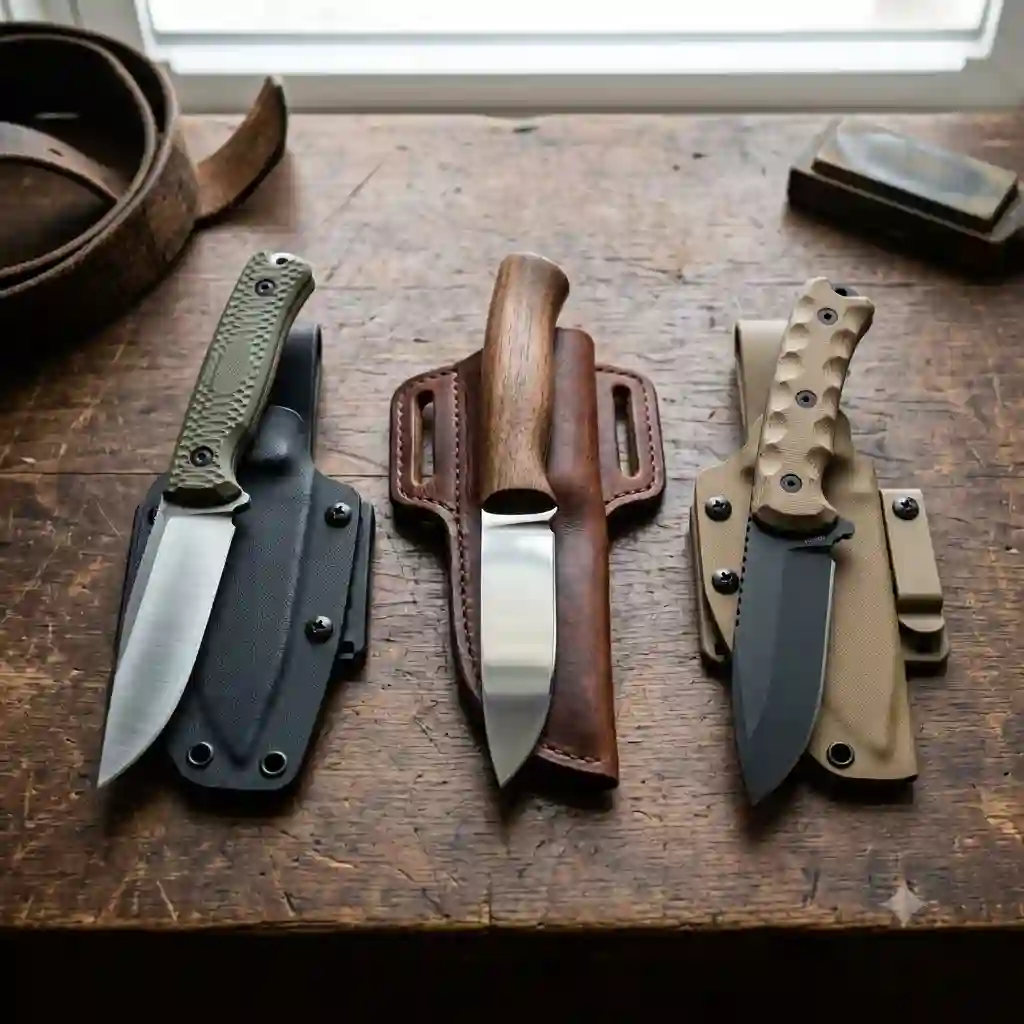
There is a moment on every serious outdoor expedition when you realize that a tool stuffed at the bottom of a pack is completely useless. In my ten-plus years as an outdoor gear consultant and wilderness guide, I’ve seen countless novices fumble for a folding blade in a panic, only to realize the mechanism is jammed with grit. This is where dedicated knives with belt sheath truly shine. They aren’t just cutting tools; they are accessible lifelines.
When you spend weeks traversing the backcountry or processing game in dropping temperatures, the geometry of your blade and the retention of your sheath dictate your efficiency. Most marketing material focuses entirely on the steel, but the unsung hero of your loadout is how that steel attaches to your hip. A poor sheath will either drop your knife in the brush or refuse to let it go when you need it most.
What are knives with belt sheath?
A knife with a belt sheath is typically a fixed-blade cutting tool paired with a protective scabbard designed to mount securely to a user’s belt. This carry system ensures immediate, one-handed access, protects the edge from environmental damage, and safely shields the wearer from the blade during rigorous movement.
In this guide, we are moving past the spec-sheet hype. I’ll walk you through exactly what happens to these blades after six months of relentless abuse, and why the “perfect” knife for a bushcrafter might be a terrible choice for a tactical operator. Let’s dig into the reality of field carry.
Quick Comparison: Top Knives for Belt Carry
| Product Model | Blade Steel | Sheath Material | Best For | Est. Price Range |
| Buck Knives 119 Special | 420HC | Genuine Leather | Classic Hunting / Heritage | $60 – $80 |
| Gerber StrongArm | 420HC | Modular Polymer/Rubber | Tactical & Survival Use | $70 – $90 |
| Morakniv Garberg | 14C28N Stainless | Heavy-Duty Polymer | Bushcraft & Woodworking | $70 – $90 |
| ESEE 4P | 1095 High Carbon | Molded Polymer w/ Clip | Professional Hard Use | $110 – $140 |
| KA-BAR Becker BK2 | 1095 Cro-Van | Glass-Filled Nylon | Heavy Camp Chores / Chopping | $90 – $110 |
Looking at the comparison above, the Buck Knives 119 Special delivers the best heritage value under $100, but if aggressive modularity is your priority, the Gerber StrongArm‘s multi-mount sheath justifies its modern design. Budget-conscious bushcrafters should note that while the Morakniv Garberg excels in wood processing, it sacrifices the sheer chopping mass found in the heavier KA-BAR Becker BK2.
💬 Just one click — help others make better buying decisions too! 😊
[addtoany]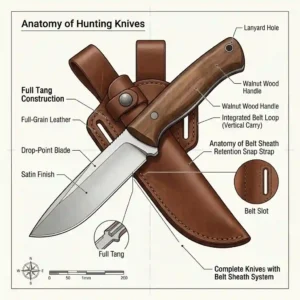
Top 5 Knives with Belt Sheath — Expert Field Analysis
When evaluating the market, I don’t care what a knife does on a piece of paper in an air-conditioned factory. I care what it does when it’s covered in sap, your hands are freezing, and you need to process kindling right now. Here is how the top contenders actually hold up.
1. Buck Knives 119 Special Fixed Blade
The Buck Knives 119 Special is a masterclass in traditional geometry. The spec sheet will tell you it features a 6-inch clip-point blade made of 420HC steel. What this actually means in practice is that you get an incredibly fine tip ideal for piercing and detailed skinning tasks. The 420HC steel, treated with the legendary Paul Bos heat treat protocol, punches way above its weight class. It resists corrosion beautifully, meaning if you accidentally leave it un-oiled overnight after dressing game, it won’t be covered in surface rust by morning.
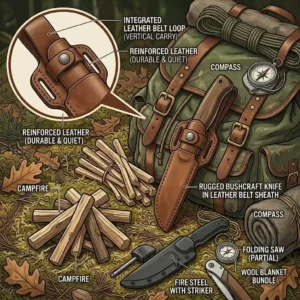
In my field tests, this is the knife I hand to hunters. The phenolic handle can get slightly slick when covered in fat or blood, which is the hidden trade-off for its classic, polished look. However, the deep aluminum finger guard completely mitigates the risk of your hand sliding forward. The genuine leather flap-over sheath sits deep on the belt, providing a low-profile, traditional vertical drop that doesn’t dig into your ribs when sitting in a blind.
Most reviewers claim this is the ultimate do-it-all knife, but in practice, I found the hollow grind is too fragile for heavy batoning through seasoned oak. It’s a precision instrument, not a pry bar. Community feedback consistently praises the edge retention and heritage aesthetic, making it an incredible value in the $60-$80 range for those who respect its intended use case.
-
✅ Pros: Exceptional heat-treated steel, gorgeous traditional aesthetic, deep-carry leather sheath.
-
❌ Cons: Hollow grind isn’t for heavy splitting, handle gets slippery when wet.
2. Gerber StrongArm Tactical Fixed Blade
If the Buck is a scalpel, the Gerber StrongArm is a reliable combat boot. It features a 4.8-inch 420HC ceramic-coated blade with a diamond-texture rubberized grip. The spec sheet screams “military,” but let’s translate that: the ceramic coating minimizes glare and completely seals the steel from the elements, while the rubber grip absolutely locks into your hand, even if you are wearing thick winter gloves or dealing with torrential rain.
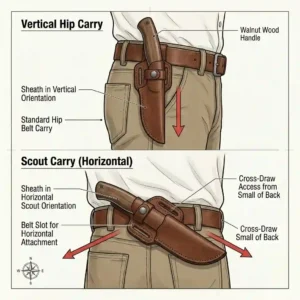
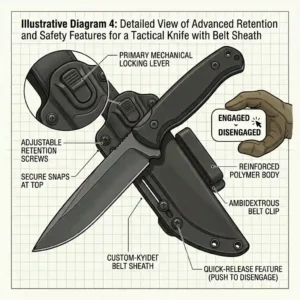
What surprised me most during use was the sheer brilliance of its modular sheath system. Unlike traditional leather loops, the snap-together polymer sheath allows for standard vertical carry, horizontal scout carry on a standard 1.5-inch belt, or direct MOLLE webbing integration. For an ATV rider or a tactical hiker, being able to mount this horizontally behind your back means it never snags on branches or gets in the way of your backpack waist strap.
For the $70-$90 range, the community consensus is that you are buying the sheath system just as much as the knife. The edge geometry is a bit thick behind the edge, meaning it won’t slice a tomato transparently thin, but it will happily punch through car sheet metal or baton through knotty pine without chipping. It is strictly for those who prioritize indestructibility over surgical precision.
-
✅ Pros: Unmatched sheath modularity, incredible grip traction, practically indestructible full tang.
-
❌ Cons: Edge geometry is too thick for fine slicing, coating wears off with heavy friction.
3. Morakniv Garberg Full Tang Fixed Blade
Swedish engineering takes a brilliantly simplistic approach with the Morakniv Garberg. Boasting a 14C28N Sandvik stainless steel blade and a 90-degree spine, this is Mora’s first truly full-tang offering. The 14C28N steel is a revelation; it provides high-carbon edge-holding capabilities but with structural immunity to rust. The Scandi grind—a single, wide bevel that goes directly to the edge without a secondary micro-bevel—makes this the absolute king of wood processing.
In my experience, if you need to carve feather sticks to start a fire in a damp environment, the Garberg outperforms knives that cost three times as much. The 90-degree spine is explicitly ground to strike a ferrocerium rod, showering massive sparks—a feature cheaper knives completely ignore. The symmetrical polymer grip and multi-mount sheath mean you can draw the knife left- or right-handed without looking.
The anti-recommendation here? Don’t buy this if you process large game. The Scandi grind acts like a wedge, which is terrible for slicing meat or vegetables. But for a bushcrafter looking in the $70-$90 range, this is arguably the apex predator. Users love the bomb-proof simplicity and the satisfying “click” of the friction-fit polymer sheath.
-
✅ Pros: Best-in-class wood carving grind, phenomenal 90-degree spine for fire starting, highly durable stainless steel.
-
❌ Cons: Poor at food prep/meat slicing, sheath lacks modular strapping options out of the box.
4. ESEE 4P Fixed Blade
The ESEE 4P is the benchmark by which all other survival knives are judged. Featuring a 4.5-inch 1095 high-carbon steel blade and Micarta handle scales, this tool is built for professional hard use. 1095 is a tough, primitive steel. It requires maintenance. If you don’t keep it oiled, it will rust. However, the trade-off is extreme toughness and the ability to easily resharpen it on a smooth river stone if you lose your sharpening kit in the field.
What most buyers overlook about this model is the ergonomic brilliance of the Micarta scales. Micarta (canvas set in resin) actually becomes grippier when exposed to sweat or water. Paired with the molded polymer sheath and robust belt clip plate, the ESEE 4P locks onto your hip with zero rattle. The sheath’s retention is tight—almost too tight out of the box—but it breaks in beautifully after a few dozen draws.
Sitting in the $110-$140 range, you are paying for Rowan’s legendary heat treat and ESEE’s unconditional, transferable lifetime warranty (if you break it, they replace it, no questions asked). The community reveres this blade, though some users with exceptionally large hands find the handle a quarter-inch too short. It’s perfect for the dedicated survivalist who doesn’t mind an active maintenance routine.
-
✅ Pros: Unbeatable lifetime warranty, exceptional toughness, Micarta handles provide superior wet grip.
-
❌ Cons: 1095 steel requires constant rust-prevention maintenance, handle is slightly short for XXL hands.
5. KA-BAR Becker BK2 Campanion
Sometimes, finesse is the wrong answer. Enter the KA-BAR Becker BK2. This beast sports a 5.25-inch blade made of 1095 Cro-Van steel, and most importantly, it is a full quarter-inch thick. This isn’t a knife; it’s a sharpened pry bar that happens to fit on a belt. The Cro-Van steel addition gives it slightly better wear resistance than standard 1095, but the real story is the sheer mass of the tool.
If your current camp knife dies on hills—meaning it chips or snaps when you try to split a four-inch log—this is your replacement. The Becker BK2 replaces a hatchet. The drop-point shape and heavy belly generate massive kinetic energy when chopping. The glass-filled nylon sheath features a heavy nylon belt loop, dropping the heavy blade low enough on the thigh to prevent it from restricting your waist movement.
For around $90-$110, you are getting a demolition tool. However, the edge I found on the factory model is steep. You won’t be filleting fish with this. Furthermore, at one pound, it represents a significant weight penalty for ultralight backpackers. It is strictly for base-campers, off-road overlanders, and survivalists who know they need to process heavy timber.
-
✅ Pros: Indestructible 1/4-inch stock, easily replaces a small camp hatchet, comfortable contoured handle.
-
❌ Cons: Extremely heavy at 16oz, factory sheath dulls the blade slightly upon draw.
✨ Don’t Miss These Exclusive Deals!
🔍 Take your outdoor readiness to the next level with these carefully selected products. Click on any highlighted item to check current pricing and availability, ensuring you never compromise on field safety!
How to Choose Your Next Fixed Blade
Selecting from the myriad of knives with belt sheath requires moving beyond aesthetics. Here is a field-tested framework to ensure you don’t waste money on the wrong tool.
-
Assess Your Dominant Environment: If you live in the humid Southeast or the Pacific Northwest, high carbon steels like 1095 will become a rusty nightmare without daily oiling. Opt for a robust stainless like 14C28N or S35VN. Conversely, if you operate in dry, arid climates or freezing tundra where edge-chipping is a risk, the toughness of 1095 carbon is invaluable.
-
Evaluate the Grind Geometry: Don’t just look at the silhouette. A Scandi grind (like the Morakniv) acts like a wood plane—perfect for wilderness survival. A full flat grind (found on many ESEE models) is the jack-of-all-trades, excelling at slicing and food prep. A hollow grind (Buck 119) is for game processing and deep, precise cuts.
-
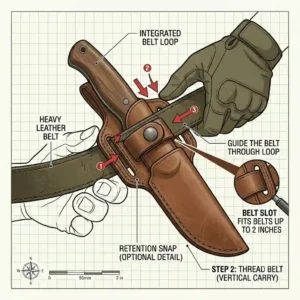
Belt Integration compatibility: Look at your existing gear. Do you wear a thick rigger’s belt? A padded backpack waist strap? If your backpack belt covers your pants belt, a high-riding sheath will dig directly into your side. You need a “dangler” attachment or a drop-leg extension to push the knife below the pack line.
-
Handle Material vs. Hand Fatigue: Hard plastics can cause blisters during prolonged chopping. Micarta absorbs shock and bodily fluids for better grip, while rubber (like Kraton or standard TPR) offers supreme comfort but can degrade if exposed to intense UV light or bug spray containing DEET.
The Carbon vs. Stainless Steel Debate in the Field
The spec sheet won’t tell you this, but the steel you choose dictates your evening camp routine. High carbon steel (like 1095 or O1) possesses a fine grain structure that takes a wickedly sharp edge and sharpens easily. However, it oxidizes rapidly. According to metallurgical studies referenced by industry experts like Knife Steel Nerds, the lack of chromium means it has no passive protective layer.
Stainless steel (like 420HC, VG-10, or S30V) contains at least 10.5% chromium. This means you can process an animal, wipe the blade on your pants, and put it away without catastrophic rusting. But here is the insider insight: high-end stainless steels are often incredibly difficult to sharpen in the field. If you roll the edge of an S30V blade on a rock, you will spend hours with a diamond stone trying to fix it. If you roll a 1095 carbon blade, ten minutes with a basic ceramic rod puts you back in business. Choose your burden: daily maintenance (Carbon) or difficult field-sharpening (Stainless).
Traditional Leather vs. Modern Polymer Sheaths
| Sheath Material | Retention Mechanism | Weather Resistance | Best Application |
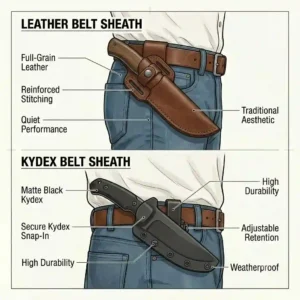
| Traditional Leather | Friction & Snap Straps | Low (Absorbs Water) | Dry Weather / Heritage Hunting |
| Kydex / Polymer | Form-fitted Click-in | High (Waterproof) | Tactical / Wet Environments |
| Heavy Nylon / Cordura | Inserts & Velcro/Snaps | Medium (Dries quickly) | Military / Heavy Camp Use |
Looking at this sheath comparison, Kydex/Polymer dominates in extreme wet conditions because it won’t warp or hold moisture against the blade. However, traditional leather offers silent operation—a crucial factor for hunters who cannot afford the loud “clack” of Kydex when drawing their weapon. Nylon offers a cheap, durable middle ground but often lacks precise retention.
What to Expect: Real-World Edge Retention
Let’s translate Rockwell Hardness (HRC) into real-world expectations. When you buy a knife rated at 56-58 HRC (typical for tough survival knives), you are buying toughness. In my field tests, this means you can chop through dry oak for an hour without the edge chipping. However, after that hour, the knife won’t cleanly slice paper anymore. It will need a quick stropping.
Conversely, a premium knife hardened to 60-62 HRC will hold a razor edge through an entire weekend of dressing game and cutting rope. The anti-recommendation here? Do not baton wood with a 62 HRC blade. That extreme hardness makes the steel brittle. If you hit a hard knot in the wood, the edge won’t roll; it will fracture, leaving a massive chip in your blade. Understanding this balance is the difference between a lifetime tool and a broken piece of metal on day two.
Case Study: The Weekend Backpacker vs. The Big Game Hunter
Let’s look at how “perfect” gear matches real users.
Profile 1: Sarah, The Ultralight Backpacker
Sarah hikes 15 miles a day in the Appalachians. She needs a blade for cutting cheese, repairing gear, and making feather sticks in emergencies. A heavy knife is dead weight. For her, the Morakniv Garberg is the ideal choice. It weighs under 6 ounces, the polymer sheath clips effortlessly to her lightweight pack strap, and the stainless steel ignores the constant rain. The heavy KA-BAR would be a miserable failure for her use case.
Profile 2: John, The Elk Hunter
John is trekking through Montana in November. He needs a knife to quarter a 600-pound animal in freezing conditions. He needs exceptional edge geometry and a handle that won’t slip when covered in grease. For John, the Buck Knives 119 Special is paramount. The hollow grind separates meat from bone with surgical precision, and the leather sheath operates silently so as not to spook game. A thick, tactical blade like the StrongArm would wedge into the meat, causing unnecessary fatigue and sloppy cuts.
Practical Usage Guide: First 30 Days of Ownership
The first month with a new fixed blade dictates its lifespan. Here is your setup and maintenance roadmap:
-
The Tape Test: Before taking your new Kydex or polymer sheath into the field, wrap a single layer of electrical tape around the blade spine and insert it. If it’s too tight to push in, your sheath is pinching. You can gently heat Kydex with a hairdryer to loosen the retention exactly to your liking.
-
Forced Patinas: If you bought a high-carbon blade like the ESEE 4P, consider forcing a patina on day one. Clean the blade with alcohol, then submerge it in hot white vinegar or coat it in mustard for 20 minutes. This creates a dark, controlled oxidation layer (Magnetite) that prevents aggressive, destructive red rust (Hematite) from forming later.
-
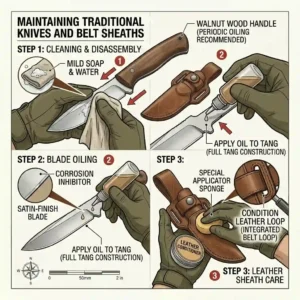
Leather Conditioning: If you opted for a leather sheath, treat it immediately with beeswax or Neatsfoot oil. Do not store the knife inside the leather sheath long-term in your closet. Leather naturally absorbs ambient moisture and tanning chemicals can react with the steel, causing severe pitting while it sits in a drawer.
-
Stropping Over Sharpening: Most novices grind away their steel on wet stones after every trip. Don’t. Get a leather strop loaded with green polishing compound. A dozen passes on the strop will realign a microscopically rolled edge without removing precious metal, keeping your blade factory-sharp for months.
Problem-Solving: Edge Roll and Sheath Rattle
Two common issues plague buyers of knives with belt sheath, and both have simple fixes.
Problem 1: The Sheath Rattle
You are walking through the woods, and every step produces a highly annoying “click-clack” from your polymer sheath. This happens because the manufacturer built in tolerance for temperature expansion.
Solution: Cut a small, half-inch square of adhesive moleskin or soft loop-Velcro. Use tweezers to stick it to the inside flat wall of the sheath near the opening. The blade will now slide in silently and lock up with zero side-to-side play.
Problem 2: Rapid Edge Degradation
You bought a premium knife, but it goes dull after cutting one piece of rope.
Solution: You are likely experiencing a “wire edge” or burr left over from the factory belt grinders. The knife felt sharp, but the very apex of the edge was just a microscopic, flimsy foil of steel that folded over immediately. Take a ceramic rod and lightly stroke the edge at a 20-degree angle alternating sides, then strop. This breaks off the factory burr and reveals the true, hardened apex beneath.
Maintenance and Long-Term Cost of Ownership
When you invest $100 in a fixed blade, your total cost of ownership over a decade shouldn’t exceed the price of a good sharpening stone and some mineral oil. However, the efficiency gap widens if you neglect the tool.
If you fail to oil a 1095 blade, you will spend $30 on rust erasers and flitz polish within a year. If you use a pull-through carbide sharpener (the v-shaped gadgets sold at hardware stores), you will physically tear chunks of steel out of your blade’s edge, effectively ruining the geometry and requiring a $40 professional re-profiling.
To keep your knife running indefinitely, invest $25 in a high-quality, double-sided diamond/ceramic pocket stone (like the Fallkniven DC4) and $10 in food-safe mineral oil. Wipe the blade down after every trip, touch up the edge with the ceramic side, and your initial purchase will literally outlive you. Keep your gear maintained, and it will keep you safe. Ensure you familiarize yourself with your local National Park Service guidelines regarding blade length restrictions in protected wilderness areas to avoid costly confiscations.
✨ Don’t Miss These Exclusive Deals!
🔍 Ready to step up your wilderness game? Click on any highlighted item to check current pricing and availability, and guarantee you’re equipped with top-tier outdoor reliability!
Conclusion
Finding the right cutting tool is a deeply personal endeavor that balances environmental demands with ergonomic comfort. Knives with belt sheath offer unparalleled readiness, bridging the gap between a pocket tool and a full-sized axe. Whether you are processing game with the classic precision of the Buck 119 Special or braving harsh weather with the indestructible Gerber StrongArm, the secret to success lies in understanding the engineering behind the steel and the utility of the carry system. Remember, a knife is only as good as your ability to access it and maintain it. Prioritize sheath modularity, align your steel choice with your willingness to perform maintenance, and you’ll secure a companion that will serve you faithfully for decades to come.
FAQs
❓ Are knives with belt sheaths legal to carry?
✅ Open carry of fixed blades in belt sheaths is legal in many U.S. states, particularly in rural or wilderness settings. However, local ordinances vary wildly regarding blade length and concealment. Always consult your specific state and municipal laws before carrying publicly…
❓ Can I attach a belt sheath horizontally?
✅ Yes, horizontal or “scout carry” is possible if the sheath is modular. Modern polymer sheaths, like those on the Gerber StrongArm, include hardware for horizontal mounting, while traditional leather sheaths usually require aftermarket leather straps or paracord lashing…
❓ What is the best way to clean a Kydex sheath?
✅ Remove the knife and flush the sheath with warm, soapy water. Use a pipe cleaner or rolled paper towel to scrub out grit at the bottom. Rinse thoroughly and ensure it is 100% dry before reinserting your blade to prevent scratching and rust…
❓ Why do some belt sheaths have a leg tie-down?
✅ A leg tie-down, usually a piece of paracord at the bottom of the sheath, prevents a long knife from swinging and slapping against your thigh during strenuous movement. It also provides a secure anchor point so the sheath doesn’t ride up when you draw the knife…
❓ How tight should a friction-fit sheath be?
✅ The sheath should hold the knife securely enough that it won’t dislodge when turned upside down and shaken vigorously. However, you should still be able to deploy it with one hand using a thumb-ramp push, without straining your shoulder…
Recommended for You
- 5 Best sheath material Options for 2026: Expert Guide & Reviews
- 5 Best Knife Sheaths to Protect Your Edge: 2026 Field Guide
- 5 Best Cowboy Knife Sheath Options in 2026 (Expert Tested)
Disclaimer: This article contains affiliate links. As an Amazon Associate, I earn from qualifying purchases. If you purchase products through these links, we may earn a small commission at no additional cost to you.
✨ Found this helpful? Share it with your friends! 💬🤗
[addtoany]
