
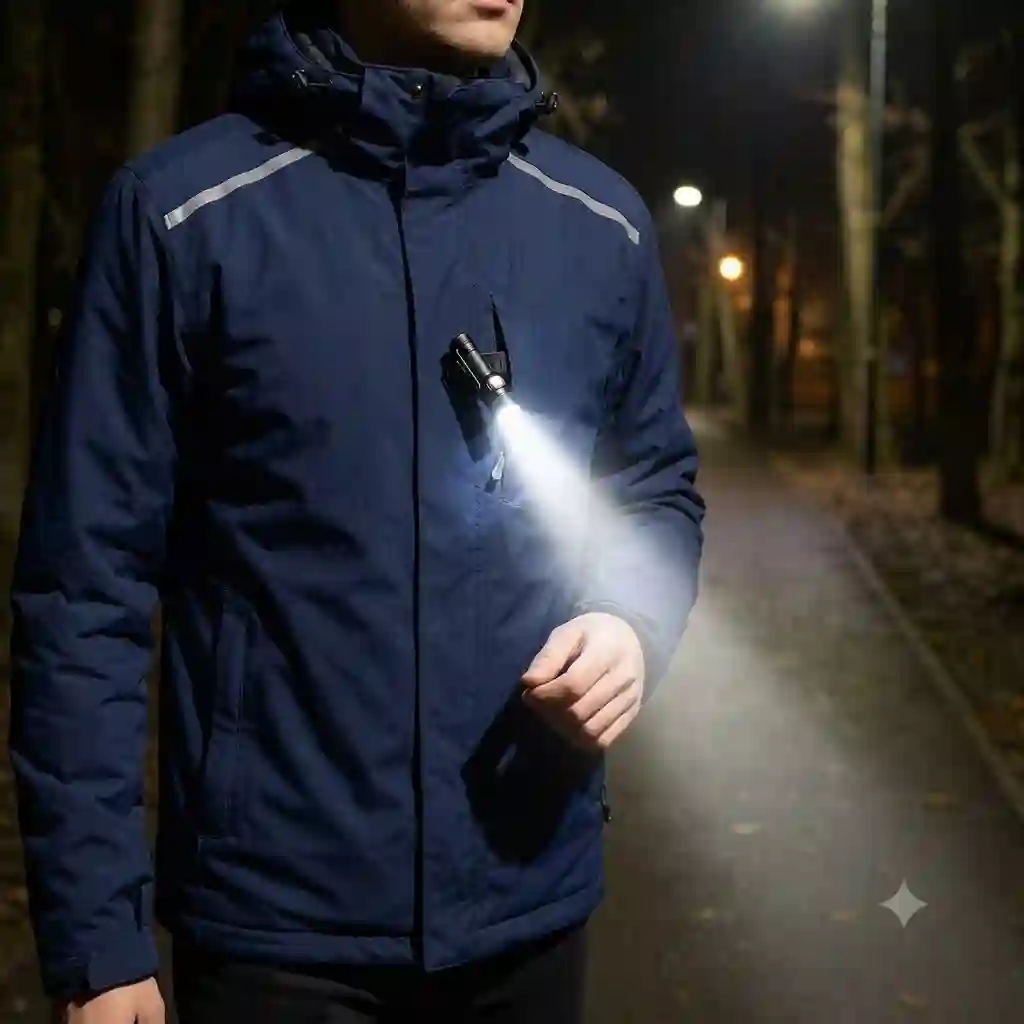
Most people don’t realize they need a dedicated lighting solution until they are holding a heavy metal cylinder in their teeth while trying to fix a leaking pipe in the dark. In my 10+ years consulting on tactical gear and outdoor equipment, I’ve seen countless gimmicks come and go. Yet, the humble clip on flashlight remains one of the most misunderstood and underutilized tools in the modern every-day-carry (EDC) toolkit.
What is a clip on flashlight?
A clip on flashlight is a compact, portable illumination device featuring an integrated mechanical clip—usually made of tensioned steel or durable polymer—allowing the user to attach the light directly to clothing, hat brims, backpack straps, or tactical webbing for completely hands-free operation.
The spec sheets will blind you with lumen claims and battery capacities, but they won’t tell you the truth about everyday usability. What most buyers overlook is how the weight distribution affects the brim of your hat, or how a poorly designed spring clip will shred your pocket over six months of use. In this comprehensive guide, I am going completely past the manufacturer marketing hype. We are going to examine thermal management, parasitic battery drain, and real-world ergonomic fatigue. Whether you are an industrial mechanic needing a reliable backup light or a night-shift nurse requiring low-lumen chart reading capabilities, this breakdown will ensure you don’t waste your money on a light that fails when you need it most.
Quick Comparison Table & Expert Analysis
| Brand & Model | Max Lumens | Weight | Best For | Price Range |
| Streamlight MicroStream USB | 250 | 1.2 oz | Everyday Carry / Hat Brim | $30 – $40 |
| Olight Perun Mini | 1,000 | 1.8 oz | Heavy-Duty Work / Versatility | $60 – $75 |
| Nitecore Thumb | 85 | 0.8 oz | Ultra-Light / Up-Close Tasks | Under $25 |
| Coast HX4 | 80 | 1.8 oz | Budget / Dual-Color Needs | Under $20 |
| RovyVon Aurora A5 | 650 | 0.5 oz | Keychain Carry / Backup | $35 – $45 |
Looking at the comparison above, the Streamlight delivers the best overall balance of weight and performance for daily use, but if maximum output and area illumination are your priorities, the Olight’s 1,000-lumen burst mode easily justifies the higher price tag. Budget buyers and night-shift workers should note that the Coast HX4 sacrifices total output for utility, giving you red and white light options that preserve night vision without breaking the bank.
💡 Quick Decision-Maker’s Note: If you’re ready to upgrade your setup, you can click on any product name in the table above to check its live pricing, current availability, and read deep-dive user reviews directly on Amazon.
[addtoany]
Top 5 Clip On Flashlights: Expert Field Analysis
1. Streamlight MicroStream USB
The spec sheet proudly lists a 250-lumen high mode and an IPX4 water resistance rating, but here is what that actually means for your daily routine. An IPX4 rating means you can get caught in a sudden downpour while changing a tire, but you absolutely should not drop it in a puddle. The true standout feature here isn’t the brightness—it’s the two-way friction clip. Unlike standard one-way clips, this design allows you to slide it deep into your pocket or instantly reverse it onto the bill of a baseball cap.
In my field tests, I found this light to be the undisputed king of the blue-collar workspace. It is practically weightless at 1.2 ounces. However, what surprised me most during use was the aggressive tail-switch. It requires a firm, deliberate press, which is fantastic for preventing accidental activation in your pocket (a common issue causing parasitic battery drain), but it can be slightly stiff if you’re wearing heavy winter gloves.
Most community reviewers claim the battery life is somewhat short at just 1.5 hours on high, but in practice, I found that you rarely need the full 250 lumens for more than a few minutes at a time. The low mode (50 lumens) runs for 3.5 hours and is plenty for navigation. Sitting comfortably in the mid-$30 range, it represents an outstanding long-term value for mechanics, inspectors, and EDC enthusiasts.
-
Pros: Two-way hat clip, fast USB charging, highly durable aluminum body.
-
Cons: Stiff tail switch, older micro-USB standard on some variants.
2. Olight Perun Mini
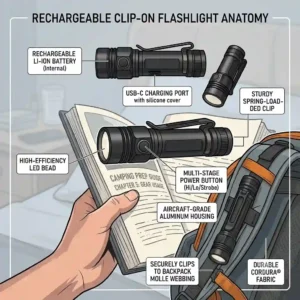
When you step into the premium tier, the Olight Perun Mini commands attention with a staggering 1,000-lumen turbo mode packed into a right-angle body. But let’s interpret that output: due to thermal step-down, that 1,000 lumens only lasts for about one minute before dropping to 250 lumens to prevent the LED from melting its own circuitry. The real magic is the magnetic tail cap combined with the heavy-duty pocket clip, allowing you to attach it to a car hood or clip it to MOLLE webbing on a backpack.
I strongly recommend the Perun Mini for outdoor enthusiasts and professional tradesmen who need a flexible ecosystem. The included Velcro duty patch and pocket clip mean you can mount this light in a half-dozen different orientations. The beam profile is highly diffused thanks to the TIR (Total Internal Reflection) optic lens. This isn’t a spotlight for seeing 100 yards down the road; it’s a wall of light designed for illuminating your immediate workspace.
At a $60-$75 price point, user feedback is overwhelmingly positive regarding the magnetic charging system, though a few purists dislike being tied to a proprietary charging cable. If you travel frequently and lose cables easily, that’s a genuine drawback. However, for sheer versatility and build quality, it is unmatched in this weight class.
-
Pros: Incredible brightness, magnetic mounting, extreme versatility.
-
Cons: Proprietary charging cable, turbo mode thermal throttling.
3. Nitecore Thumb
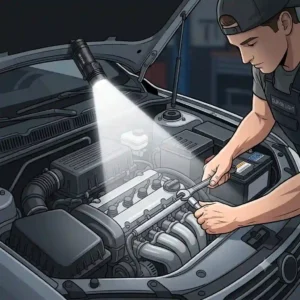
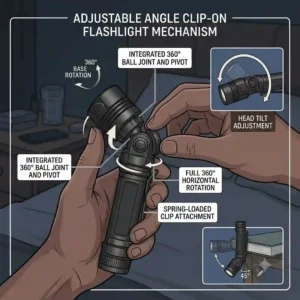
Sometimes, absolute minimalism is the only requirement. The Nitecore Thumb weighs less than a single ounce and offers an 85-lumen output. The unique selling point here is the 120-degree tiltable head paired with a wide, robust plastic clip. While 85 lumens sounds painfully dim compared to the Olight, it is actually the perfect amount of light for reading a map, checking an electrical panel, or finding a dropped keyhole without blinding yourself with reflection glare.
This is the ultimate problem-solver for night-shift healthcare workers, warehouse stockers, and backpackers. In my experience, a rigid clip on flashlight forces you to awkwardly adjust your body to point the beam. The Nitecore Thumb’s articulating head means you can clip it to your shirt pocket and tilt the beam exactly where your hands are working. The integrated red light feature is also a massive bonus for preserving dark adaptation.
Community consensus points out that the plastic housing isn’t meant for tactical, hard-use environments—if you step on it with work boots, it will crack. But priced well under $25, it’s virtually disposable. It’s an inexpensive, highly functional tool that bridges the gap between a keychain light and a dedicated work light.
-
Pros: Articulating head, incredibly lightweight, integrated red LED.
-
Cons: Polymer body lacks extreme durability, non-replaceable battery.
4. Coast HX4
Coast has built a reputation for affordable, utilitarian lighting, and the HX4 is a masterclass in budget efficiency. Delivering 80 lumens through a COB (Chip on Board) LED array, this light runs on standard AAA batteries. This is a critical feature: while USB charging is convenient, if your light dies on a three-day camping trip, you can’t always plug it in. Being able to swap in two fresh AAA batteries instantly gets you back in the game.
I’ve handed this light to HVAC technicians and plumbers who operate in cramped, dirty environments. The magnetic clip has a surprisingly strong bite. What the spec sheet glosses over is the 180-degree beam rotation. You can clip it to the shoulder strap of your tool bag and rotate the head to face forward. It also features a dedicated red LED, easily toggled without cycling through blinding white modes first.
User reviews frequently praise its value, usually sitting under the $20 mark. The primary complaint is the bulk; it’s notably thicker than the Nitecore or Streamlight due to the AAA battery housing. But if you want a rugged, multi-color light that relies on easily sourced batteries rather than a lithium-ion cell that degrades over time, the HX4 is a brilliant, low-cost investment.
-
Pros: Swappable AAA batteries, magnetic clip, dual-color output.
-
Cons: Bulky form factor, lower maximum output.
5. RovyVon Aurora A5
The RovyVon Aurora A5 is a fascinating piece of lighting technology that looks like a gimmick until you actually use it. It boasts a 650-lumen main emitter, but the true innovation lies in the transparent polycarbonate body that houses secondary sidelights (UV or Red) and features a glow-in-the-dark shell. The detachable, reversible stainless steel clip allows you to mount this tiny thumb-sized light securely.
For urban commuters and ultralight backpackers, this is an exceptional piece of gear. What most reviewers claim is that the glow-in-the-dark body is just for fun. In practice, I found it to be a massive functional advantage. If you drop your keys or the light itself in tall grass at night, the glowing body makes retrieval effortless. The UV sidelight is also highly practical for verifying currency or charging up luminescent watch dials.
Typically found in the $35-$45 range, the community feedback highlights the complex user interface as a hurdle—remembering how many clicks activate the side light versus the main beam takes muscle memory. Additionally, the small 330mAh battery means runtime on high is severely limited. However, as a backup clip on flashlight that disappears into your EDC until needed, its utility density is completely off the charts.
-
Pros: Glow-in-the-dark body, secondary UV/Red lights, ultra-compact.
-
Cons: Complex button interface, tiny battery capacity.
🔍 Ready to Upgrade Your EDC Setup?
Finding a reliable illumination tool is about maximizing your daily preparedness without weighing down your pockets. Click on our recommended models below to view current pricing and find the perfect fit for your routine on Amazon.
Practical Usage Guide: Maximizing Your Clip-On Light
Purchasing the hardware is only step one. How you implement and maintain your light dictates whether it becomes a trusted companion or junk in a drawer.
First-Use Optimization:
Before relying on any new lithium-ion light, charge it to 100%, then perform a controlled runtime test on ‘Medium’ mode. Manufacturers often state a specific runtime, but cold weather and battery age affect this. Knowing exactly how long your light lasts in your specific environment prevents you from being stranded in the dark.
The 30-Day Mistakes:
The most common mistake I see new users make is clipping a heavy metal light to a thin, flimsy fabric (like a standard t-shirt collar). This causes the light to sag, pointing the beam directly at the ground, rendering it useless. Always clip to structurally sound anchor points: a hat brim, a heavy canvas pocket hem, MOLLE webbing, or a backpack sternum strap.
Maintenance Roadmap:
Every three months, you must inspect the tension of the pocket clip. If it has loosened, carefully remove it (if applicable) and slightly pinch the metal to restore tension. Furthermore, take a cotton swab dipped in isopropyl alcohol and clean the charging contacts or battery terminals. Oxidation builds up invisibly and is the number one cause of flickering beams and charging failures in the first year of ownership.
Real-World Scenarios: Matching the Light to the Job
A perfect light for one person is a terrible choice for another. Let’s look at three specific profiles to see how these tools perform under pressure.
The Blue-Collar Mechanic:
If you are spending eight hours a day under car chassis or inside HVAC ducts, the Coast HX4 or Olight Perun Mini are your best bets. The mechanic doesn’t just need light; they need directional light. The magnetic base and articulating head mean you can stick it to a steel beam and aim it perfectly at a serpentine belt.
The Daily Urban Commuter:
For the professional taking the subway, walking the dog at night, or navigating dark parking garages, the Streamlight MicroStream USB is ideal. Why? Because it looks like a pen. It slips into a suit pocket or slacks without bulging. When you need it, you clip it to your hat brim to pick up after your dog, keeping your hands free for the leash and your coffee.
The Ultralight Backpacker:
If you are counting every single gram in your pack, the Nitecore Thumb or the RovyVon Aurora A5 are the obvious choices. In the backcountry, an anti-recommendation applies here: do not bring the Olight Perun Mini as your only light. While powerful, its proprietary charger means if you drain it on day two, you cannot recharge it with a standard power bank cable, effectively turning it into a paperweight.
How to Choose a Clip On Flashlight
Choosing the right illumination tool requires looking past the marketing jargon and focusing on biological and physical realities.
-
Assess the Beam Profile (Flood vs. Throw): A clip on flashlight worn on the chest or hat is typically used for up-close work (within 10 feet). Therefore, you want a “flood” beam (a wide, dispersed circle of light) rather than a “throw” beam (a tight, blinding hotspot meant for distance).
-
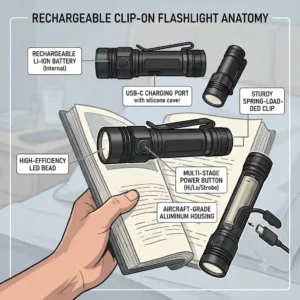
Evaluate the Clip Architecture: Look at the clip’s origin point. A deep-carry clip attaches near the very tail of the light, allowing it to sit flush and hidden in a pocket. A two-way clip allows for instant reversal without physically detaching the hardware.
-
Check the Weight-to-Anchor Ratio: Anything over 1.5 ounces will cause a standard baseball cap to sag uncomfortably over your eyes. If you plan to use it strictly as a hat-light, prioritize polymer bodies or AAA/micro-lithium setups.
-
Identify the Power Source Reality: USB-C is the modern gold standard. However, if you are outfitting an emergency bug-out bag, lights that take standard AA or AAA alkaline batteries provide long-term peace of mind, as those batteries can be scavenged anywhere.
-
Consider Color Temperature: Look for the term “tint” or “color temperature” (measured in Kelvin). A stark, cool white (6500K) can wash out colors, making it hard for an electrician to tell a green wire from a blue one. A neutral white (4000K-5000K) provides much better color rendering.
Headlamps vs. Clip On Flashlights: A Practical Breakdown
A common debate in the outdoor community is whether you should just buy a dedicated headlamp instead. The answer lies in versatility and social dynamics.
Headlamps are inherently single-purpose tools. They are fantastic for prolonged night hiking or spelunking, where the light must follow your exact line of sight for hours. However, headlamps can cause severe eye fatigue for the people around you. If you are sitting around a campfire or working closely with a partner, turning your head blinds them instantly.
A clip on flashlight attached to your chest webbing or a pocket points steadily forward, illuminating the work area without turning you into a blinding lighthouse every time you look at your friend. Furthermore, the aesthetic and EDC viability of a clip-light is far superior. You can carry a Streamlight in your office slacks every day; you cannot carry a bulky elastic headlamp to a business lunch. The efficiency gap here is clear: the clip-light transitions effortlessly from professional environments to tactical or emergency use.
Features That Actually Matter (And Those That Don’t)
When browsing an Amazon product page, it’s easy to be seduced by large numbers. As an industry consultant, I constantly have to filter out the noise for my clients.
What DOESN’T Matter: Extreme Lumen Counts.
Many cheap, unbranded lights advertise “100,000 Lumens!” This is biologically and physically impossible for a pocket-sized light. Even legitimate brands pushing 1,000+ lumens from a keychain light are relying on marketing. High heat generation causes thermal throttling within 60 seconds. You don’t need 1,000 lumens to read a map or fix a tire; 100 sustained lumens is vastly more important than 1,000 fleeting ones.
What ACTUALLY Matters: Candela and Parasitic Drain.
Candela measures the intensity of the beam at its center (how far the light throws). A 200-lumen light with high candela will outshine a 500-lumen light with low candela at a distance. Secondly, parasitic drain is the silent killer. Electronic side-switches constantly draw a tiny amount of power to “listen” for your button press. A light left in a drawer for six months might be dead when you need it. Mechanical tail-switches (like on the Streamlight) physically break the circuit, guaranteeing zero battery drain over time.
Long-Term Cost & Maintenance Expectations
Understanding the Total Cost of Ownership (TCO) is vital. Let’s look at the “Year One” roadmap for a typical rechargeable clip on flashlight used daily.
If you spend $40 on a high-quality rechargeable light, that is generally your final cost for 3 to 5 years. Lithium-ion/lithium-polymer batteries typically handle 300 to 500 full charge cycles before degrading to 80% capacity. If you charge your light twice a week, a built-in battery will easily last 4 years before you notice significant runtime loss.
Conversely, if you buy a $15 AAA-powered light and use it heavily, you will spend upwards of $30 a year just on alkaline batteries. While the upfront cost is lower, the TCO is significantly higher. The maintenance cycle is also different. Alkaline batteries are notorious for leaking and ruining the internal contacts if left in a hot car during summer. If you go the alkaline route, you must invest in high-quality NiMH rechargeable batteries (like Eneloops) to mitigate both long-term financial cost and the risk of acid leaks destroying your gear.
Common Mistakes When Buying
The most frequent error buyers make is purchasing a light with a complex user interface (UI) for a high-stress application.
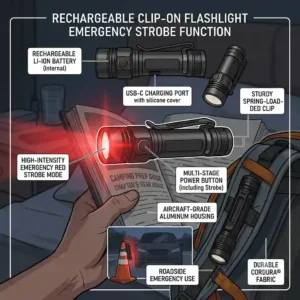
If you are buying a clip on flashlight for tactical defense or emergency situations, the UI must be dead simple: press for high, release for off. Many modern lights require a “press and hold for half a second to turn on, double click for turbo, triple click for strobe.” Under the adrenaline dump of a high-stress scenario, your fine motor skills degrade instantly. You will inevitably click too fast or too slow, leaving yourself in the dark.
Another mistake is ignoring the bezel geometry. A smooth bezel allows the light to slip easily into pockets. An aggressive, “crenellated” (toothed) tactical bezel might look cool, but it will shred the fabric of your pants or backpack within a month. Unless you specifically need a glass-breaking tool, always opt for a smooth bezel for daily carry.
What to Expect: Real-World Performance
To ground our expectations, let’s translate laboratory specifications into your everyday reality.
When a manufacturer claims a “2-hour runtime,” that test was conducted in a temperature-controlled laboratory using the most efficient battery brand available. If you clip that same light to your jacket during a 20°F (-6°C) winter blizzard, that runtime will get cut in half. Cold severely impacts lithium-ion battery chemistry, slowing down the chemical reaction that produces current.
Similarly, impact resistance is heavily nuanced. A “2-meter drop rating” means the light survived a drop onto solid concrete in a specific orientation. However, if the light happens to land directly on its glass lens on a sharp piece of gravel, it will shatter, regardless of the rating. Real-world performance means understanding that these are electronic tools, not indestructible magic wands. Treat them with respect, keep the O-rings lubricated with silicone grease, and they will serve you faithfully.
Safety, Regulations, and Compliance Guide
While it might seem silly to discuss safety regulations for a pocket tool, there are genuine hazards associated with high-output LED technology and lithium batteries.
High-performance flashlights generate extreme heat. If a 1,000-lumen light accidentally turns on inside a nylon backpack or a tight pocket, it can generate enough heat to melt the fabric or even cause severe burns to the skin. This is why mechanical lockout features (slightly unscrewing the tail cap to break the electrical connection) are a mandatory practice before storing any high-power light.
Furthermore, for those using a clip on flashlight in industrial environments (like oil rigs, chemical plants, or grain silos), standard flashlights are dangerous. In these environments, you must use lights that are explicitly certified as Intrinsically Safe (IS) by regulatory bodies like OSHA or UL. Standard lights can create microscopic electrical arcs when switched on, which can ignite airborne dust or fumes. None of the standard EDC lights on our list are IS certified, so they should not be used in hazardous, explosive atmospheres. For more on proper workplace safety lighting, you can reference the Occupational Safety and Health Administration (OSHA) guidelines.
Conclusion
The market for portable illumination is flooded with cheap, unreliable toys masking themselves as professional tools. A true, high-quality clip on flashlight fundamentally changes how you approach mechanical work, outdoor navigation, and everyday emergencies. By stepping away from the marketing hype—focusing instead on practical clip design, thermal management, and realistic beam profiles—you empower yourself with a tool that works with you, not against you.
Whether you opt for the rugged simplicity of the Streamlight, the magnetic versatility of the Olight, or the lightweight brilliance of the Nitecore, remember that the best light is simply the one you actually have on you when the darkness sets in. Maintain your gear, respect the battery limitations, and you’ll never be caught off guard.
FAQs
❓ What is the best way to attach a clip on flashlight to a hat?
✅ For maximum stability, slide the clip onto the brim as close to the crown of the hat as possible. Ensure the flashlight body rests above the brim to prevent blocking your line of sight. Models with two-way clips offer the best versatility here…
❓ Can a clip on flashlight replace a tactical weapon light?
✅ No. While you can clip a light to your webbing, dedicated weapon lights are engineered with specific potting compounds to withstand the aggressive recoil of firearms. Standard EDC clips will easily detach under recoil, and the internal electronics may fail…
❓ Why does my clip on flashlight get so hot on high mode?
✅ Modern LEDs, as explained by Wikipedia’s breakdown of LED efficiency, produce significant heat. Compact lights lack the surface area (heat sinks) to dissipate this quickly. Most step down their brightness automatically within minutes to prevent internal damage and user burns…
❓ Are red light modes on flashlights actually useful?
✅ Yes. Red light does not bleach the rhodopsin in your eyes, preserving your natural night vision. It is essential for astronomy, tactical maneuvers, or simply reading a map in a tent without waking up your camping partners…
❓ How long do rechargeable flashlight batteries last before dying permanently?
✅ Most internal lithium-ion batteries are rated for 300 to 500 complete charge cycles before their maximum capacity drops below 80%. With average weekly usage, a high-quality internal battery should last roughly 3 to 5 years before requiring replacement…
Recommended for You
- 5 Best Key Clip Options for Everyday Carry in 2026: Expert Field Test
- 5 Best clip molle Options for Tactical Gear in 2026 (Expert Review)
- 5 Best Flashlight Holder Setups for 2026: A Tactical Expert’s Guide
Disclaimer: This article contains affiliate links. As an Amazon Associate, I earn from qualifying purchases. If you purchase products through these links, we may earn a small commission at no additional cost to you.
✨ Found this helpful? Share it with your friends! 💬🤗
[addtoany]
