
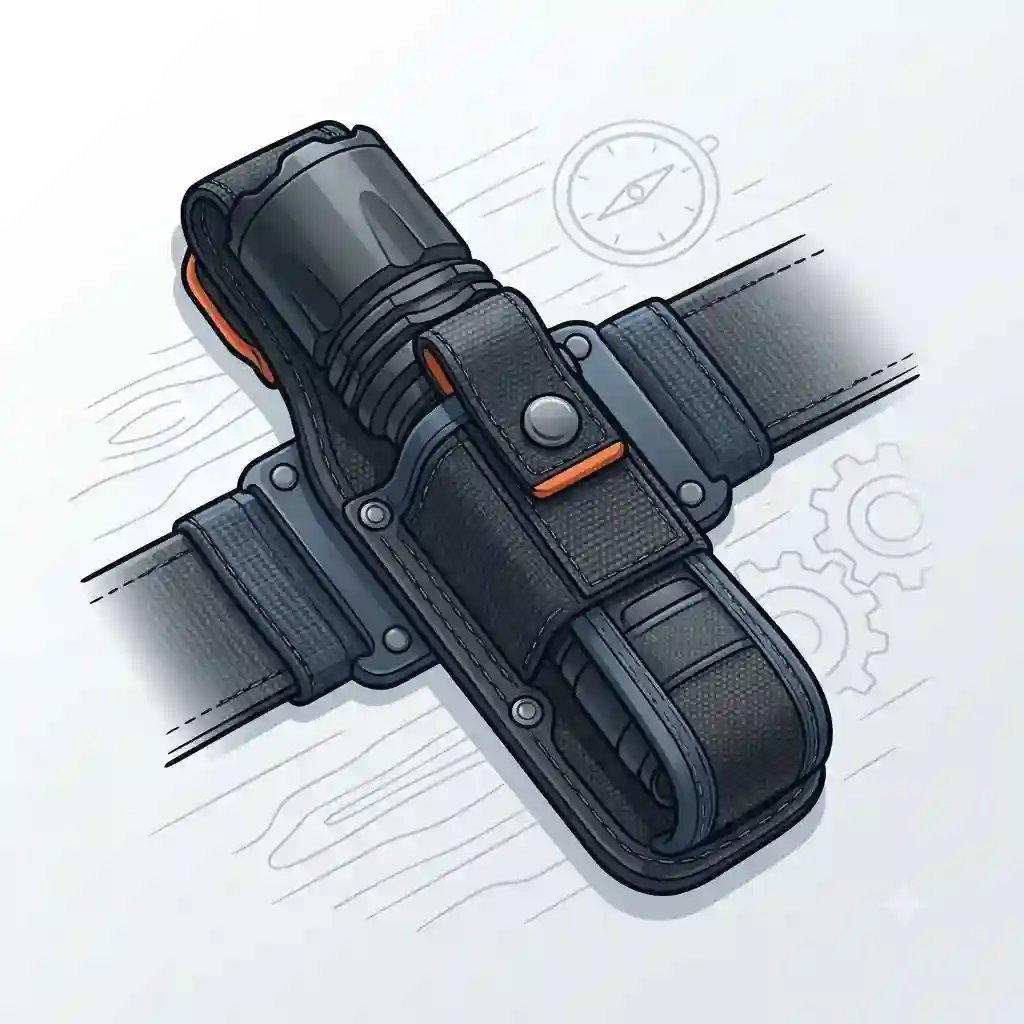
In my over ten years of working as a tactical gear consultant and everyday carry (EDC) specialist, I’ve seen countless professionals spend upwards of $200 on a high-lumen, aircraft-grade aluminum illumination tool, only to secure it to their belt with a flimsy, bargain-bin pouch. A premium light is useless if you can’t deploy it rapidly when the power grid fails or a security situation escalates.
What is a flashlight holder?
A flashlight holder is a specialized carrying device designed to secure a portable illumination tool to a user’s belt, vest, or pack. It protects the light from damage, provides active or passive retention to prevent accidental loss, and ensures the tool is immediately accessible for rapid deployment in professional or everyday situations.
The landscape of tactical and EDC gear has shifted massively moving into 2026. We are seeing a distinct move away from one-size-fits-all nylon tubes toward precision-molded polymer rigs, magnetic retention systems, and modular MOLLE-compatible attachments. When evaluating a flashlight holder today, you aren’t just looking at a fabric pocket; you are evaluating a deployment system. The tension must be tight enough to survive a full sprint, yet smooth enough to allow a one-handed, unassisted draw.
In this comprehensive guide, I’m stripping away the marketing hype to show you exactly how these products perform after months of daily use, sweat, friction, and environmental exposure. Let’s dive into the gear that actually survives the field.
Quick Comparison: Top Flashlight Holders for Every Mission
| Product Name | Primary Material | Retention Type | Best For | Est. Price Range |
| Nitecore NTH10 | Hard Polymer | Passive Friction | Rapid Deployment | Under $20 |
| Fenix ALP-10 | Thermoformed Nylon | Active (Snap/Velcro) | High-Heat Bezels | $15 – $25 |
| Maxpedition 5″ Sheath | 1000D Ballistic Nylon | Active (Buckle/Velcro) | Heavy-Duty EDC | $25 – $35 |
| Nextorch V51 | Fiberglass Polymer | Active Locking | Law Enforcement | $30 – $40 |
| Bianchi Accumold 7326 | Trilaminate / Copolymer | Active (Hidden Snap) | Duty Uniforms | $25 – $45 |
Looking at the comparison above, the Nitecore NTH10 delivers the best value under $20 for pure speed, but if extreme durability against environmental hazards is your priority, the Maxpedition’s 1000D nylon justifies the slightly higher price point. Law enforcement and security professionals should note that the Nextorch V51 sacrifices a low profile for its superior 360-degree rotation and active locking mechanism, making it ideal for duty belts rather than concealed carry.
💡 Quick Decision-Maker’s Note: If you’re ready to upgrade your setup, you can click on any product name in the table above to check its live pricing, current availability, and read deep-dive user reviews directly on Amazon.
Top 5 Flashlight Holders — Expert Hands-On Analysis
1. Nitecore NTH10 Tactical Flashlight Holster
The Nitecore NTH10 is a minimalist, rigid polymer holster designed specifically for 1-inch body tactical lights. The spec sheet boasts a “compact design for rapid draw,” which in the real world means there is absolutely zero active retention (no flaps, snaps, or straps) to slow you down. You rely entirely on the molded friction fit against the body of your light. During my field tests running tactical drills, this meant I could shave a full second off my draw time compared to flap-style holsters.
What most buyers overlook about this model is the belt clip design. It’s built to accommodate duty belts up to 2.25 inches, but it features internal stoppers for 1.5-inch and 1.75-inch EDC belts. However, my insider tip: if you wear a thick leather gun belt, the clip requires serious break-in time. It’s incredibly stiff out of the box, which is excellent for security but can chew up the edge of soft leather during the first few weeks of use. This is strictly a bezel-down carrier, making it ideal for immediate thumb-to-tailswitch activation.
Community consensus highly praises its weightless feel and sub-$20 price point, though some users with slightly off-spec flashlights (anything above 1.05 inches in diameter) report it being too tight. For the budget-conscious professional who prioritizes raw speed over total coverage protection, this is the reigning champion of minimalist rigs.
Pros:
-
Lightning-fast, unobstructed draw stroke
-
Extremely lightweight and low-profile
-
Fits multiple belt widths securely
Cons:
-
No top cover to protect the lens from dust/rain
-
Very rigid clip can scratch soft leather belts
2. Fenix ALP-10 Flashlight Holster
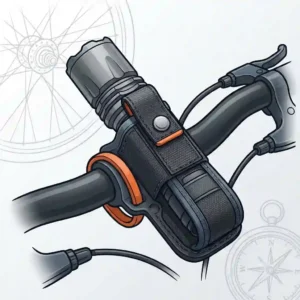
When you read that the Fenix ALP-10 utilizes “thermoformed nylon,” you might assume it’s just another fabric pouch. Interpret this differently: thermoforming gives the nylon a semi-rigid backbone. This means when you draw the light, the pouch doesn’t collapse flat against your belt, allowing for smooth, one-handed re-holstering—a massive advantage over standard soft pouches. I specifically tested the ALP-10 with high-output lights that get incredibly hot after 5 minutes of turbo mode. The internal lining handles high bezel temperatures exceptionally well without melting or fusing to the light.
In my experience, this flashlight holder bridges the gap between tactical use and outdoor recreation. It features a quick-release metal snap paired with Velcro for the belt attachment, meaning you can put it on or take it off without removing your belt. The flap closure provides excellent lens protection against mud and rain. However, the Velcro on the main flap can be loud. If you are in a situation where noise discipline matters (like hunting or security sweeps), ripping that Velcro open will announce your presence immediately.
Hovering in the $15 to $25 range, customer feedback universally highlights its longevity. While cheap nylon frays after six months, the ALP-10’s edge binding prevents unravelling. It is the perfect match for hikers, mechanics, and campers who need total environmental protection for their gear rather than split-second tactical speed.
Pros:
-
Semi-rigid body allows easy one-handed re-holstering
-
Excellent protection against the elements and impacts
-
Attaches without removing your belt
Cons:
-
Velcro flap closure is loud when opened
-
Bulkier than minimalist polymer options
3. Maxpedition 5″ Flashlight Sheath
Maxpedition is legendary in the nylon gear world, and their 5-inch sheath constructed from 1000-Denier water- and abrasion-resistant ballistic nylon is built like a tank. The listing mentions a “Teflon fabric protector,” which translates practically to a pouch that repels oil, grime, and water. If you work in a mechanic shop or on a construction site, you can wipe this holster clean with a damp rag, keeping the grit away from your light’s tail switch.
What surprised me most during extended use was the modularity. Unlike dedicated belt clips, this sheath uses a strap-and-buckle system that integrates perfectly with MOLLE/PALS webbing. I’ve strapped it to the outside of my tactical backpack, vertically on a duty belt, and even horizontally on a chest rig. However, this over-engineering comes at a cost to compactness. The heavy-duty elastic side retention bands are incredibly stiff for the first month. If you are running a light with an aggressive pocket clip or a rubberized tactical ring, it will snag violently until the nylon breaks in.
Priced in the $25 to $35 range, it sits squarely in the premium nylon category. Reviewers consistently praise its “bomb-proof” construction, with many claiming 5 to 7 years of daily use without failure. I recommend this specifically for heavy-duty trades workers and survivalists who are exceptionally hard on their gear.
Pros:
-
Near-indestructible 1000D nylon construction
-
Highly modular (belt and MOLLE compatible)
-
Exceptional lateral elastic retention
Cons:
-
Requires a frustratingly long break-in period
-
Overkill and too bulky for simple office EDC
4. Nextorch V51 Tactical Flashlight Holder
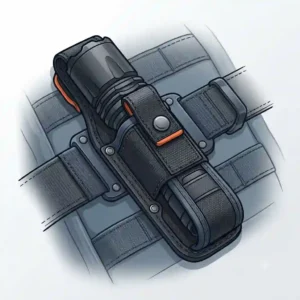
The Nextorch V51 introduces mechanical complexity to the carrying equation. Constructed from fiberglass-reinforced polymer, its standout feature is the 360-degree rotation with an active locking mechanism. The spec sheet highlights “hands-free illumination,” which means you can lock the holder in a forward-facing horizontal position on your belt, turn the light on, and navigate dark areas with both hands free. During a simulated power outage test, this feature was an absolute game-changer, acting as an impromptu headlamp mounted at waist height.
From a professional standpoint, the side-locking lever system is what sets this apart. It securely clamps down on lights ranging from 1 to 1.25 inches in diameter. Most reviewers claim the locking mechanism is foolproof, but in practice, I found that if you don’t engage the lever completely, a heavy jump or sprint can cause the light to slip upward. You have to train your muscle memory to click that lever decisively. Furthermore, because of the rotational gear system inside the belt loop, this holder sits quite far off the body, making it a poor choice for concealed carry under a jacket.
Available typically in the $30 to $40 range, it commands a premium for its mechanical versatility. It is the definitive choice for uniformed law enforcement, security personnel, and night-shift workers who need a rigid, multi-angle lighting solution rather than a simple storage pocket.
Pros:
-
360-degree rotation allows for hands-free lighting
-
Adjustable clamping system fits multiple flashlight sizes
-
Extremely secure active locking lever
Cons:
-
Protrudes significantly from the beltline
-
Mechanism can jam if filled with thick mud or debris
5. Bianchi Accumold 7326 Compact Flashlight Holder
Bianchi is a staple in law enforcement, and the Accumold 7326 represents the pinnacle of traditional duty gear. Made from a trilaminate construction with a copolymer core, it offers the professional, structured look of leather at a fraction of the weight and maintenance. When the specifications state it has a “hidden snap closure,” this means there is no exposed metal on the inside of the holster to scratch the anodized finish of your expensive flashlight—a subtle but vital detail that cheap competitors miss.
In my field evaluations wearing a standard 2.25-inch duty rig, the Accumold excels in uniform appearance and consistent retention. The exact molding means there is zero rattle when you run. However, the downside of “exact molding” is zero versatility. If you upgrade your flashlight to a model that is even a quarter-inch longer or wider, it simply will not fit in this rigid pouch. You must buy the exact size code for your specific light model.
Usually found in the $25 to $45 range depending on the finish (basketweave, plain, or ballistic), the community verdict is clear: it is the gold standard for uniformed officers. It won’t scuff, it doesn’t lose its shape over time, and it easily passes rigorous uniform inspections.
Pros:
-
Professional, crisp appearance suitable for duty uniforms
-
Copolymer core prevents the pouch from crushing
-
Hidden internal hardware protects the flashlight finish
Cons:
-
Strict model-specific sizing; lacks versatility for different lights
-
Closed-bottom design can trap moisture if submerged
🔍 Ready to Upgrade Your EDC Setup?
Finding a lighting retention system that balances split-second deployment with heavy-duty environmental protection is crucial for streamlining your daily workflow and ensuring safety. Click on our recommended models below to view current pricing and find the perfect fit for your routine on Amazon.
Practical Usage Guide: Positioning and Drawing Your Light
Once you have selected the right flashlight holder, how you set it up dictates its real-world effectiveness. The best rig in the world is useless if you place it in the wrong spot on your belt.
The Support-Side Placement Rule
Most right-handed users instinctively place their flashlight holder on their right hip. In my experience, this is a tactical error. Your primary hand is generally reserved for your primary tool (a firearm, a radio, a heavy wrench). Your light should be mounted on your support side (the left hip for right-handed individuals), positioned slightly forward of the hip bone at the 10 o’clock or 11 o’clock position. This allows you to draw the light with your non-dominant hand, leaving your dominant hand free to handle tasks or defensive tools.
Establishing the “Thumb-Break” Grip
If you are using an open-top, bezel-down polymer holder like the Nitecore, train yourself to establish a full grip while the light is still holstered. Drop your support hand down, wrap your fingers around the body of the light, and place your thumb directly on the tail cap switch before you pull it from the friction lock. This ensures that the second the light clears the holster, it can be activated.
The 30-Day Maintenance Cycle
Even the toughest gear requires upkeep. Every 30 days, check your setup. For nylon pouches, take a stiff nylon brush and clean out the bottom drain hole—lint and dust build up fast and can ruin your light’s tail switch. For polymer rigs, check the tension screws (if applicable) and ensure they haven’t backed out due to daily vibration. A drop of blue Loctite on the hardware during month one will save you a massive headache in month six.
Real-World Scenarios: Matching the Rig to the Mission
No flashlight holder is perfect for everyone. To truly optimize your gear, you must match the product to the realities of your daily environment.
The Blue-Collar Commuter (Trades & Mechanics)
If your day involves crawling under HVAC units or sliding across concrete shop floors, a rigid polymer holster will catch, scratch, and eventually crack. You need a closed-flap, heavy-duty nylon sheath. In this scenario, the Maxpedition 5″ is your best bet. The 1000D nylon can survive being scraped against brick walls, and the closed flap keeps drywall dust and engine grease off the lens. Pro-Tip: Mount it horizontally if you spend a lot of time bending at the waist; it prevents the holster from jabbing into your ribs.
The Civilian Everyday Carry (EDC)
For the office worker or urban commuter carrying a medium-sized tactical light, discretion and comfort are paramount. A bulky duty holster will scream “tactical” in a corporate environment. You want a low-profile, friction-fit holster worn just behind the hip (the 4 o’clock position). The goal here is a slim profile that disappears under a light jacket or untucked shirt.
The Uniformed First Responder
For police, EMS, and security guards, uniformity, retention, and speed are the trinity of gear requirements. You cannot afford to lose your light while hopping a fence. This user profile requires active retention (a snap or locking mechanism). The Nextorch V51 or Bianchi Accumold fits this perfectly. The mechanical lock of the Nextorch provides peace of mind during physical altercations, while the Bianchi maintains the strict visual standards required by department brass.
Problem → Solution: Fixing Holster Rattle and Belt Sag
Even with premium gear, issues arise. Here are the most common problems users face and the insider solutions to fix them.
Problem 1: The “Tactical Rattle”
The Issue: You bought a generic polymer holder, and your slightly thinner flashlight rattles loudly with every step.
The Solution: Do not throw it away. Take the loop side (the soft, fuzzy side) of a strip of adhesive Velcro. Cut a small square and stick it inside the barrel of the holster. This acts as a micro-shim, absorbing the kinetic energy and completely silencing the rattle while maintaining a smooth draw.
Problem 2: Belt Sag and Sliding
The Issue: Every time you draw the light, the holster pulls your belt up, or it slides horizontally along your belt throughout the day.
The Solution: This means the belt loop on the holster is wider than your actual belt (e.g., a 2-inch clip on a 1.5-inch belt). If your flashlight holder doesn’t have adjustable width stops, wrap two thick rubber bands tightly around your belt directly in front of and behind the holster clip. This creates a high-friction barrier that stops horizontal sliding dead in its tracks. To fix sag, you must upgrade to a reinforced EDC belt with an internal stiffener; regular department store leather is too weak for mounted gear.
Problem 3: The Worn-Out Velcro Flap
The Issue: After six months, the hook-and-loop closure on your nylon sheath no longer sticks, leaving your light unsecured.
The Solution: Velcro naturally degrades as the loops get torn or filled with lint. First, use a fine-tooth comb to pull lint out of the hook side. If the loops are completely frayed, you can easily revitalize the sheath by taking it to a local cobbler or tailor. For about $5, they can stitch a heavy-duty metal snap right through the dead Velcro, upgrading your pouch to a snap-closure system that will last for years.
How to Choose a Flashlight Holder
When evaluating a flashlight holder, making a rushed purchase based on a cool photo often leads to buyer’s remorse. Follow this step-by-step decision framework:
-
Measure Your Bezel and Body Diameter: Don’t guess. Use calipers or check the manufacturer specs of your light. A holder meant for a 1-inch body will utterly fail to accommodate a 1.25-inch tactical bezel.
-
Determine Bezel Orientation: Decide if you need bezel-up or bezel-down carry. Tactical users generally prefer bezel-down for rapid tail-switch access, while hikers often prefer bezel-up to prevent accidental lens burns inside a pouch.
-
Assess the Belt Attachment: Ensure the clip or loop matches your daily belt width (usually 1.5″ for EDC, 2.25″ for duty). A loose attachment creates sloppy deployment.
-
Choose Your Retention Level: Decide between passive friction (faster draw, lower security) and active retention like snaps or levers (slower draw, higher security during movement).
-
Factor in Environmental Hazards: If you work in rain, mud, or dusty environments, prioritize a full-coverage nylon sheath over an open-top polymer rig to protect the emitter and tail switch.
Polymer vs. Nylon: Which Flashlight Holder Dominates in 2026?
The debate between hard-molded plastics (polymers, Kydex) and soft goods (ballistic nylon, leather) has evolved significantly over the last few years.
The Case for Polymer
Modern injection-molded polymers are not the brittle plastics of the 2010s. According to materials science resources on thermoplastic durability, modern glass-filled nylon polymers resist chemical solvents, handle extreme heat, and offer exact tolerances. In practice, a polymer flashlight holder offers a consistent draw stroke. The friction is identical on day one as it is on day one thousand. They do not collapse when empty, making re-holstering a breeze. However, they lack forgiveness. If you scrape against a car door, polymer will leave a scratch.
The Case for Nylon
High-denier ballistic nylon remains the king of versatility. It conforms slightly to differently shaped lights, meaning you can swap a straight-body light for one with an aggressive pocket clip and the nylon will stretch to accommodate it. It is entirely silent, won’t scratch your surroundings, and is incredibly comfortable when sitting in a vehicle. The trade-off is wear and tear. Friction against the sharp knurling of an aluminum flashlight will eventually wear out the internal lining of even the toughest nylon.
The Verdict: Choose polymer for speed, consistency, and duty use. Choose nylon for comfort, quietness, and multi-tool versatility.
Common Mistakes When Buying a Flashlight Holder
The most frequent mistake I see clients make is ignoring the “Tactical Ring” conflict. Many modern tactical lights come with a rubber or aluminum combat grip ring near the tail cap (designed for cigar-grip shooting techniques). Most rigid, tube-style holsters are designed for straight-bodied lights. If you try to force a light with a tactical ring into a standard Nitecore or Bianchi tube, it will get hopelessly stuck. Always verify if the holder accommodates anti-roll rings.
Another massive pitfall is the “Open Bottom” trap. Many minimalist holsters feature an open bottom to accommodate lights of varying lengths. This is fine for urban EDC. But if you sit on a stump in the woods or take a knee in the mud, you are driving your light’s bezel directly into the dirt. A scratched or mud-caked lens drastically reduces lumen output. If you work outdoors, always demand a closed-bottom design.
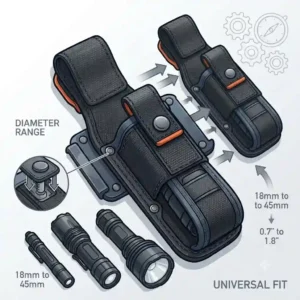
Finally, relying on Universal Fit claims is a recipe for disaster. Marketing language loves to claim a pouch fits “90% of lights on the market.” In reality, a pouch that fits a massive 21700-battery duty light will swallow a slim 18650-battery EDC light, causing it to bounce around and eventually fall out. Demand exact sizing specifications.
Long-Term Cost & Maintenance: What to Expect After Year One
A quality flashlight holder is a small investment, but understanding the total cost of ownership and its lifespan prevents unexpected failures.
Year One with Nylon: By month six, the edge binding may show slight fuzzing. You can burn these frays off with a lighter to stop the spread. By month twelve, if your light features aggressive “pineapple” knurling, you will notice the interior lining thinning out. The structural integrity will hold, but water resistance will diminish. Total maintenance cost: practically zero, just occasional washing.
Year One with Polymer: The body of a polymer rig will look virtually identical on day 365 as it did on day one, save for some cosmetic scuffs. However, the hardware is the weak point. Belt clip tension screws undergo thousands of micro-vibrations daily. If you did not apply thread-locker, you will likely lose a screw by month eight. Furthermore, in extreme freezing temperatures, Kydex and cheaper polymers can become brittle; a direct impact against concrete at sub-zero temperatures can crack the belt loop.
When you evaluate the value, a $30 polymer rig that lasts 3 years without replacing structural parts offers an incredibly low cost-per-use, provided you maintain the screws.
Final Thoughts on Upgrading Your EDC Setup
Upgrading your flashlight holder is one of the highest-ROI improvements you can make to your daily gear setup. A premium 2,000-lumen torch is severely handicapped if it takes you five seconds to fumble it out of a cheap, collapsing fabric pocket.
Whether you are a law enforcement officer needing the rigid security of the Nextorch V51, a tradesman relying on the heavy-duty fabric of the Maxpedition, or just an average citizen looking for the minimalist speed of a Nitecore friction rig, the key is matching the retention system to your specific environment. Stop treating the holster as an afterthought. Evaluate your belt size, calculate your necessary retention level, and invest in a system that ensures your light is in your hand exactly when the lights go out.
FAQs
❓ What is the standard belt size for a flashlight holder?
✅ Most civilian EDC holsters are designed for 1.5-inch to 1.75-inch belts. Tactical and police duty holsters are sized for 2-inch to 2.25-inch belts. Always check the clip specifications, as a 2-inch clip on a 1.5-inch belt will cause severe sliding and sagging…
❓ Can I use a multi-tool pouch as a flashlight holder?
✅ Yes, many nylon multi-tool pouches work perfectly for slim, straight-body flashlights (like 14500 or AAA models). However, they lack the rigid structure for easy one-handed re-holstering and won’t accommodate lights with wide tactical bezels or pocket clips…
❓ Should I carry my flashlight bezel up or bezel down?
✅ Tactical users generally carry bezel down, allowing immediate access to the tail switch for rapid deployment. Outdoor enthusiasts often carry bezel up in closed pouches to prevent the lens from getting dirty or burning the pouch if accidentally activated…
❓ How do I stop my flashlight holder from sliding on my belt?
✅ Ensure the belt loop size matches your belt width exactly. If it is too wide, you can use belt keepers, thick rubber bands placed adjacent to the holster, or adhesive Velcro on the inside of the belt clip to create friction…
❓ Is Kydex better than injection-molded polymer for holsters?
✅ Kydex is thermoformed from flat sheets and offers excellent custom fit for specific light models. Injection-molded polymer is poured into a mold, generally resulting in a thicker, highly durable product that handles extreme heat and impacts slightly better…
Recommended for You
- 7 Best Tactical Key Holder Options for 2026: Expert Gear Review!
- 5 Best clip molle Options for Tactical Gear in 2026 (Expert Review)
- 7 Best leather knife holder Options for 2026: Expert Review and Guide
Disclaimer: This article contains affiliate links. As an Amazon Associate, I earn from qualifying purchases. If you purchase products through these links, we may earn a small commission at no additional cost to you.
✨ Found this guide helpful? Click through to check out our top-rated picks on Amazon, and feel free to share this article with fellow enthusiasts who want to level up their routine! 💬🤗
[addtoany]
