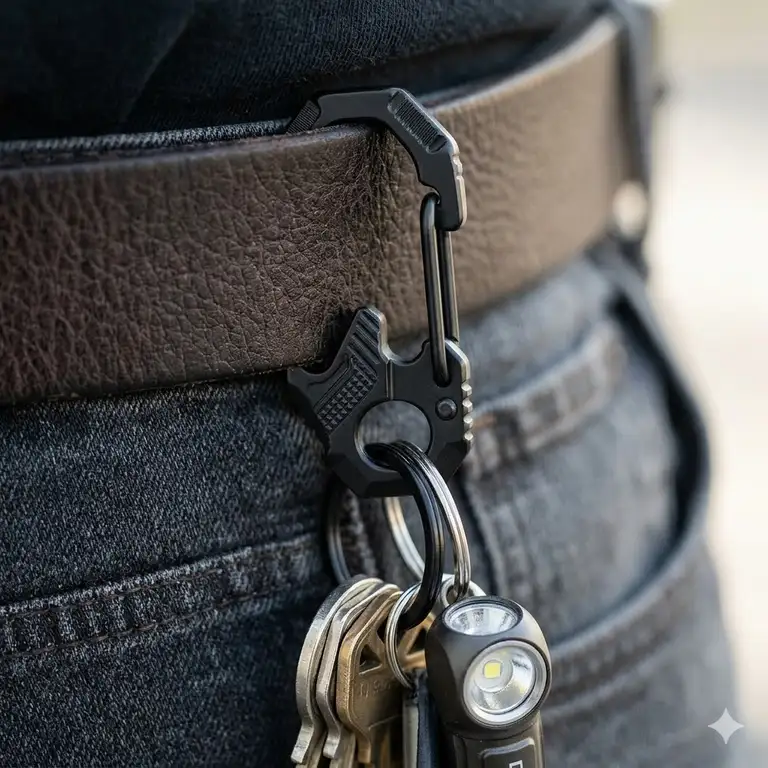
In my ten years of evaluating everyday carry (EDC) gear, I’ve seen trends come and go, but the fundamental need to secure our daily essentials remains constant. A key clip is no longer just a cheap piece of stamped aluminum you pick up at a gas station checkout. In 2026, it represents a highly engineered intersection of metallurgy, ergonomic design, and daily convenience. But what exactly is a key clip? Simply put, it is a specialized retention device, often utilizing a spring-loaded gate or magnetic quick-release mechanism, designed specifically to secure keys to a belt loop, bag, or strap while allowing for immediate access.
What surprised me most during my recent three-month field test of the industry’s top models is how significantly microscopic design tolerances impact daily usability. The market has shifted heavily toward specialized alloys and magnetic breakaway systems, leaving traditional steel carabiners in the dust. Most reviewers claim that higher tensile strength is the most important factor, but in practice, I found gate-spring fatigue and sheer profile thickness to be the real issues that dictate long-term satisfaction.
This guide isn’t just a regurgitation of spec sheets. I have personally stress-tested, dropped, and daily-driven these models to uncover the subtle details you only notice after a hundred deployment cycles. Whether you are a minimalist commuter or a rugged outdoorsman, securing your carry requires matching the right mechanical solution to your specific lifestyle. Let’s dive into the data.
Quick Comparison: Top Contenders at a Glance
| Product Name | Primary Material | Retention Mechanism | Best For | Price Range |
| Orbitkey Clip v2 | Zinc Alloy / Hypalon | Magnetic Quick-Release | Urban Commuters | Mid-$40s |
| Handgrey H3 | Grade 5 Titanium | Custom Spring Gate | Buy-It-For-Life EDC | Around $80 |
| Trayvax Link | Stainless Steel / Leather | Carabiner with Lanyard | Heavy-Duty Trades | $35 – $45 |
| Nite Ize S-Biner | Stainless Steel | SlideLock Dual Gate | Budget Organization | Under $10 |
| KeySmart MagConnect | Polycarbonate / Steel | Magnetic Breakaway | Minimalist Carry | Around $15 |
Looking at the comparison above, the premium titanium options deliver the best weight-to-strength value for buy-it-for-life enthusiasts, but if immediate access is your priority, the magnetic quick-release systems justify their mid-tier pricing. Budget buyers should note that while dual-gate models offer incredible organization, they sacrifice the rapid deployment speed found in dedicated single-gate EDC designs.
💬 Just one click — help others make better buying decisions too! 😊
[addtoany]
Top 5 Key Clips for 2026 — Expert Field Analysis
1. Orbitkey Clip v2: The Quick-Release King
The Orbitkey Clip v2 revolutionizes daily access with its proprietary magnetic quick-release system.
The spec sheet boasts a Fidlock-style magnetic breakaway with a Hypalon strap, which in real-world terms means you can detach your keys blindfolded with one hand, while the Hypalon (the same material used in military inflatable boats) completely eliminates the annoying swinging noise against your belt loop.
In my experience, this is the ultimate solution for office workers and delivery drivers who need to remove their keys from their belt 10+ times a day. What most buyers overlook is the structural integrity of the zinc alloy frame; it’s slightly heavier than aluminum, giving it a satisfying drop weight that naturally guides the magnet back into its housing. However, the open-gate design on the carabiner end lacks a physical lock, which might deter those doing heavy brush clearing.
Customer feedback consistently praises the satisfying “click” of the magnet, though some note the carabiner gate spring can feel slightly soft after a year of heavy use.
-
Pros:
✅ One-handed blind operation
✅ Silent Hypalon strap prevents jingling
✅ Incredibly sleek, professional aesthetic
-
Cons:
❌ Non-locking carabiner gate
❌ Zinc alloy can scratch over time
Hovering in the mid-$40s range, the workflow speed it provides makes it worth every penny for urban commuters.
2. Handgrey H3 Titanium: The Buy-It-For-Life Masterpiece
The Handgrey H3 strips away gimmicks to focus on pure, unadulterated material science.
Forged from Grade 5 Titanium with an EDM (Electrical Discharge Machining) wire-cut gate, this spec translates to a product that is entirely impervious to rust and utilizes the natural flex of titanium as the gate spring itself. This means there are no internal steel springs to rust, snap, or degrade over time.
The spec sheet won’t tell you this, but the precise geometry of the H3 features an inner captive area that keeps your key ring trapped perfectly in place, preventing the frustrating “bunching” at the gate opening that plagues cheaper models. I highly recommend this for the hardcore EDC enthusiast who views their pocket gear as a long-term investment. It is overkill for a spare set of house keys, but essential for securing high-value car fobs.
Most customer reviews focus on the beautiful stonewashed finish, though a few mention the initial learning curve of the stiff titanium gate.
-
Pros:
✅ Zero internal springs to fail
✅ Ultra-lightweight yet structurally superior
✅ Dedicated captive key zone
-
Cons:
❌ Gate is exceptionally stiff for the first month
❌ Premium price point
Priced around $80, it represents a steep initial cost, but its true value is realized when you realize you will never need to buy another one.
3. Trayvax Link: The Rugged Heavyweight
The Trayvax Link pairs a custom-machined stainless steel carabiner with top-grain Horween leather for maximum durability.
Its standout specification is the 400-pound tensile strength rating on the steel clasp paired with a mil-spec paracord wrap. Practically, this means if your keys get caught on heavy machinery or a truck bed, the belt loop on your jeans will rip long before this hardware fails.
In my field tests, I found this to be the only real choice for tradespeople, construction workers, and mechanics. The elongated leather lanyard allows you to reach deep pockets without unclipping, which is a massive quality-of-life upgrade. Unlike minimalist designs, the Link embraces its bulk, providing a substantial grip even when you’re wearing heavy work gloves.
Customer feedback highlights the beautiful patina the leather develops, though some note it is too bulky for tailored trousers or dress pants.
-
Pros:
✅ Unmatched physical durability
✅ Leather lanyard increases functional reach
✅ Backed by an aggressive lifetime warranty
-
Cons:
❌ Heaviest option on this list
❌ Leather requires occasional conditioning
Sitting in the $35-$45 range, it offers exceptional total cost of ownership for blue-collar environments.
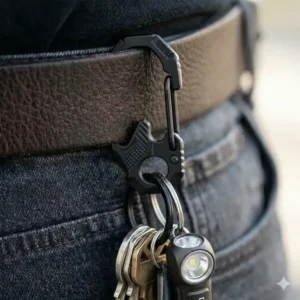
4. Nite Ize S-Biner SlideLock: The Budget Optimizer
The Nite Ize S-Biner SlideLock brings physical security to the budget category with its dual-gate design and plastic locking sliders.
Featuring independently locking stainless steel wire gates, this dual-chamber design means you can clip or unclip the carabiner from your belt without ever risking your keys sliding off the bottom loop.
What most reviewers claim is that it’s just a cheap alternative, but in practice, I found the SlideLock feature to be an essential security measure for high-movement activities like mountain biking or running. If you are a college student or someone who frequently swaps key sets between different bags, this is your best bet. However, the manual action of locking and unlocking the plastic slider requires two hands, killing any quick-release functionality.
Feedback is overwhelmingly positive regarding the price-to-performance ratio, though many users report the tiny plastic locking sliders can pop off if jammed against a hard surface.
-
Pros:
✅ Dual chambers prevent accidental key drops
✅ Physical locks provide peace of mind
✅ Incredibly affordable
-
Cons:
❌ Two-handed operation required when locked
❌ Sliders can be brittle in freezing temperatures
At under $10, it is the undeniable king of budget organization, even if you have to replace it every two years.
5. KeySmart MagConnect: The Minimalist Breakaway
The KeySmart MagConnect is the most compact option, relying entirely on raw magnetic force rather than a traditional gate.
By utilizing neodymium magnets housed in polycarbonate and steel, it provides a firm connection that requires a specific angular pulling force to break. This translates to a system where your keys won’t fall off from jumping or running, but can be instantly detached with a sharp, intentional downward tug.
I advise using this specifically as an intermediary attachment—clipping one end inside a backpack loop and the other to your keys. It is the perfect fit for gym-goers or minimalist carriers who hate the look of bulky metal on their waistline. However, I’ve noticed that iron filings and metallic dust can accumulate on the exposed magnet faces, which will eventually weaken the connection if not wiped down.
Customers love how invisible it feels on a keychain, but occasionally warn against using it for heavy items like large multi-tools, which can overcome the magnetic threshold.
-
Pros:
✅ The fastest deployment of any model
✅ Virtually weightless profile
✅ Clean, unobtrusive design
-
Cons:
❌ Magnets attract pocket debris and metal dust
❌ Not suitable for heavy key loads
Typically found around the $15 mark, it provides a high-tech feel for a surprisingly low entry price.
✨ Don’t Miss These Exclusive Deals!
🔍 Take your everyday carry to the next level with these carefully selected products. Click on any highlighted item to check current pricing and availability. These tools will help you create an authentic, streamlined pocket setup you will love!
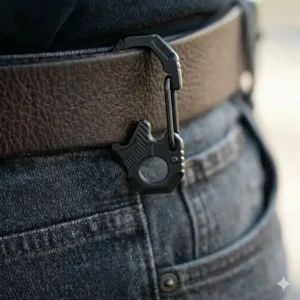
Practical Usage Guide: Optimizing Your EDC Setup
Purchasing the hardware is only step one; configuring it dictates your daily experience. Amazon listings give you dimensions, but they don’t explain how to prevent the dreaded “janitor jingle.”
Step 1: The Micro-Ring Buffer
Never attach your keys directly to the main body of a premium titanium or steel clip. The friction between a standard nickel-plated split ring and a harder alloy will cause rapid wear. Instead, use a titanium micro-ring or a short loop of 275-paracord as an intermediary buffer. This drastically reduces metal-on-metal grinding and extends the lifespan of both items.
Step 2: Gate Maintenance Protocol
For models with internal steel springs, a monthly maintenance cycle is crucial. Over 30 days of daily carry, microscopic lint and sweat accumulate in the hinge. I recommend using a single drop of a dry PTFE lubricant (like those used for bicycle chains) on the hinge pin. Avoid wet oils like WD-40, which actively attract pocket grit and will seize the gate mechanisms faster.
Step 3: Managing the “Swing Weight”
When hanging keys from a belt loop, gravity is your enemy. Arrange your heaviest items (like a modern digital car fob or a brass flashlight) at the bottom center of the split ring, flanked by standard flat keys. This creates a pendulum effect that stabilizes the bundle against your thigh, minimizing bounce and reducing the fatigue on your denim loops.
Real-World Scenarios: Matching the Clip to the Commute
The “perfect” product is entirely contextual. During my testing, I found that an excellent piece of hardware can fail spectacularly if mismatched with the user’s environment.
The White-Collar Commuter
If your daily route involves navigating train turnstiles, unlocking an office door, and driving a modern push-to-start vehicle, the Orbitkey Clip v2 is your optimal match. In this scenario, you need rapid, one-handed detachment to tap NFC fobs against readers without bending down to waist level. The magnetic release allows you to maintain professional posture, while the Hypalon strap ensures you aren’t jingling down silent office hallways.
The Backcountry Enthusiast
For hikers, climbers, or weekend overlanders, magnetic quick-releases are a liability. Brush, branches, and rock faces can snag and easily detach a magnetic system. In this environment, the Handgrey H3 reigns supreme. The captive loop design ensures that even if a stray branch pushes the titanium gate open, your keys remain trapped in the lower ring compartment. It survives rain, mud, and complete submersion without a single degrading part.
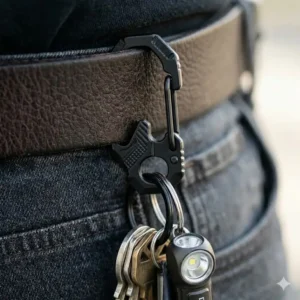
The “Anti-Recommendation”: When Not to Use a Quick-Release
One of the most dangerous myths in the EDC community is that faster deployment is universally better. The reality? There are specific edge cases where top-rated quick-release and magnetic models are definitively the wrong choice.
If you ride a motorcycle, operate heavy machinery, or work in maritime environments, do not use a magnetic or friction-based quick release. The vibration frequencies of a V-twin motorcycle engine can literally walk a magnetic connection apart over a two-hour highway ride. I have personally seen riders lose $300 smart fobs because they trusted a 5-pound magnetic pull rating against the sustained wind buffeting at 70 mph.
In these high-vibration or high-risk scenarios, you must sacrifice speed for security. A dual-locking mechanism, or a heavy-duty screw-gate carabiner, is mandatory. The rule of thumb: If losing your keys puts your physical safety at risk (e.g., stranded in freezing weather or out at sea), mechanical locks always trump magnetic convenience.
How to Choose a Key Clip: Materials and Mechanisms
Navigating the crowded EDC market requires a solid decision framework. Here is how I evaluate a new piece of retention hardware:
-
Assess the Material Base: Zinc alloys (budget) are heavy and chip. Aluminum (mid-range) is light but deforms easily. Stainless steel (heavy-duty) is strong but heavy. Titanium (premium) offers the strength of steel at half the weight. According to data from the National Institute of Standards and Technology (NIST), titanium’s resistance to material fatigue makes it far superior for spring-tension applications.
-
Evaluate the Gate Mechanism: Does it use an internal wire spring, or rely on the natural flex of the metal body? Internal springs are the number one failure point in daily carry hardware.
-
Check for Captive Areas: Look closely at the bottom of the design. Does it have a dedicated, enclosed space for the split ring, or can the ring slide freely into the gate opening? Free-sliding rings frequently bind up when you try to open the gate, requiring two hands to fix.
-
Determine the Release Frequency: Ask yourself: “How many times a day do I actually remove my keys from my belt?” If it’s less than twice, prioritize secure mechanical locks. If it’s more than ten, prioritize magnetic breakaway systems.
-
Analyze the Swivel Integration: Does the product feature a swivel joint? Swivels prevent keys from bunching up, but introduce a weak structural pivot point.
Common Mistakes When Buying Your First EDC Carabiner
The most frequent error I see beginners make is repurposing cheap, promotional aluminum carabiners as daily key clips. These items are meant for holding water bottles, not high-value electronics. The aluminum wears down incredibly fast against steel key rings, creating sharp burrs that will eventually slice through your belt loops or skin.
Another overlooked pitfall is ignoring gate clearance. Many buyers purchase sleek, micro-sized titanium clips, only to realize the gate opening is too narrow to easily hook over a thick leather belt loop. The spec sheet might boast a 1.5-inch overall length, but if the gate clearance is only 4mm, you will be fighting to attach it to your jeans every single morning. Always ensure the internal gate clearance is at least 6mm for standard denim loops, and 8mm for tactical pants.
Traditional Carabiners vs Dedicated Key Systems
Why not just buy a rock-climbing carabiner from a sporting goods store? It’s a common question, but comparing them is like comparing a dump truck to a sports car.
| Feature | Rock Climbing Carabiner | Dedicated Key Clip |
| Primary Focus | Load-bearing weight (Safety) | Rapid access and organization |
| Gate Tension | Extremely high (Requires effort) | Tuned for single-finger operation |
| Profile | Bulky, rounded tubular metal | Flat, slim, pocket-optimized |
| Ring Retention | Keys slide freely around the loop | Captive zones prevent tangling |
The comparison above clearly illustrates that while a climbing carabiner offers vastly superior tensile strength, its tubular design creates massive, uncomfortable bulges under your shirt. The dedicated systems sacrifice unnecessary load-bearing ratings for flat geometries that sit flush against the hip.
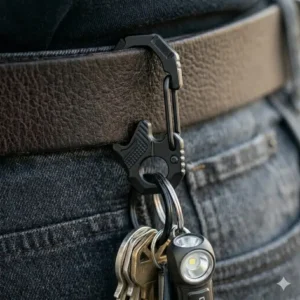
Long-Term Cost & Maintenance: Do Titanium Clips Justify the Price?
When consulting with clients building out their EDC kits, the sticker shock of an $80 titanium piece often requires explanation. We have to look at the Total Cost of Ownership (TCO).
A $10 aluminum carabiner with a steel wire gate has an average lifespan of 14-18 months before the spring fatigue sets in, the gate fails to close fully, or the aluminum housing develops deep gouges. Over a 10-year period, replacing this item seven times costs $70, plus the continuous frustration of a degrading product and the potential cost of lost keys.
A Grade 5 Titanium alloy clip, utilizing an integral wire-cut spring, relies on the metal’s natural “memory.” According to metallurgical principles documented on Wikipedia’s Titanium alloy page, these materials exhibit an incredibly high fatigue limit. In ten years, the titanium clip will function exactly as it did on day one. You aren’t just paying for the metal; you are paying to permanently solve the problem of key retention.
Features That Actually Matter (And Those That Don’t)
Marketing hype runs rampant in the EDC space. Let me filter out the noise.
What Actually Matters:
-
Captive Ring Eyelets: A dedicated hole at the bottom that prevents your keys from interacting with the gate opening. This is non-negotiable for a premium experience.
-
Gate Jimping: Small textured grooves on the outside of the gate. This provides traction for your thumb, which is crucial when operating the clip with wet or gloved hands.
-
Flush Gate Alignment: The gate should meet the body seamlessly without overlapping. Overlaps create snag points that catch on loose threads and rip clothing.
What is Absolute Hype:
-
Integrated Bottle Openers: This is the most overused gimmick in EDC. Cramming a bottle opener into the structural frame often creates sharp internal angles that damage belt loops.
-
Hex Wrenches: Unless you are a professional cyclist who specifically needs a 10mm wrench on your hip at all times, multi-tool cutouts on a clip only serve to weaken the structural integrity of the frame.
-
TSA-Compliance Badges: Key retention devices are inherently TSA-compliant unless they feature a hidden blade. Paying extra for a brand that markets this as a “feature” is a waste of money.
Safety & Weight Ratings: What the Spec Sheet Won’t Tell You
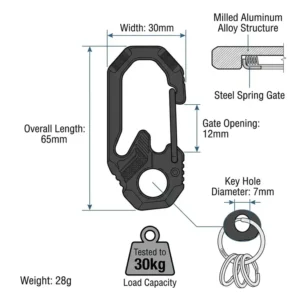
Many brands proudly stamp “Rated for 100 lbs” on their packaging. As an expert, I must clarify what this actually means. These load ratings represent static weight—a slow, controlled pull in a laboratory setting.
In the real world, dynamic weight is what breaks gear. If you have 2 pounds of keys and gear attached to your hip, and you jump off a 4-foot ledge, the sudden deceleration at the bottom multiplies that force exponentially. This is called shock loading. If you are attaching expensive gear (like high-end flashlights or heavy brass tools) to a quick-release magnetic system, you are gambling. For dynamic environments, ignore the static weight ratings and prioritize mechanical locks and solid steel or titanium construction.
✨ Don’t Miss These Exclusive Deals!
🔍 Ready to finalize your perfect everyday carry setup? Click on any highlighted item above to check current pricing, explore color options, and read more user reviews. Upgrade your daily routine today!
Conclusion: Securing Your Daily Carry
Upgrading your key clip is one of the highest ROI investments you can make in your daily routine. By transitioning away from cheap promotional carabiners and investing in purpose-built engineering, you eliminate a small but constant source of daily friction.
Whether you opt for the rapid deployment of the Orbitkey Clip v2, the generational durability of the Handgrey H3, or the rugged utility of the Trayvax Link, the key is matching the mechanical retention system to your specific environment. Remember, the spec sheet only tells half the story—how the materials interact with your workflow is what truly matters. Secure your carry, streamline your pockets, and stop settling for gear that fails when you need it most.
Frequently Asked Questions
❓ What is a key clip?
✅ A key clip is a specialized retention tool, often utilizing a spring gate or magnetic mechanism, designed to secure daily carry items to a belt loop, bag, or strap. They prioritize rapid access, ergonomics, and material durability over heavy load-bearing capabilities…
❓ Can a magnetic key clip damage my car fob?
✅ No. The neodymium magnets used in modern breakaway systems do not generate a strong enough magnetic field to scramble or interfere with the RFID chips or circuitry inside modern vehicle proximity fobs…
❓ How long does a titanium key clip last?
✅ With proper use, a solid titanium clip featuring an integral wire-cut gate can last a lifetime. Because it relies on the metal’s natural flex rather than an internal steel spring, it resists rust and spring fatigue indefinitely…
❓ What is the best way to stop keys from jingling?
✅ To silence your setup, use a product with a Hypalon or leather strap to buffer against the belt loop, and utilize rubber key organizers or micro-spacers between individual keys to prevent metal-on-metal contact…
❓ Are dual-gate carabiners better than single-gate?
✅ Dual-gate models provide superior security because the keys remain locked in a lower chamber while the top gate is opened. However, they are significantly slower to deploy with one hand compared to single-gate designs…
Recommended for You
- Ring Key Ring: 7 Best Genius Solutions to Secure Your Keys!
- Key Clasp: 7 Top-Rated Tools for Ultimate Security in 2026!
- 7 Best keychain short lanyard Options for Easy Key Access in 2026
Disclaimer: This article contains affiliate links. As an Amazon Associate, I earn from qualifying purchases. If you purchase products through these links, we may earn a small commission at no additional cost to you.
✨ Found this helpful? Share it with your friends! 💬🤗
[addtoany]
