
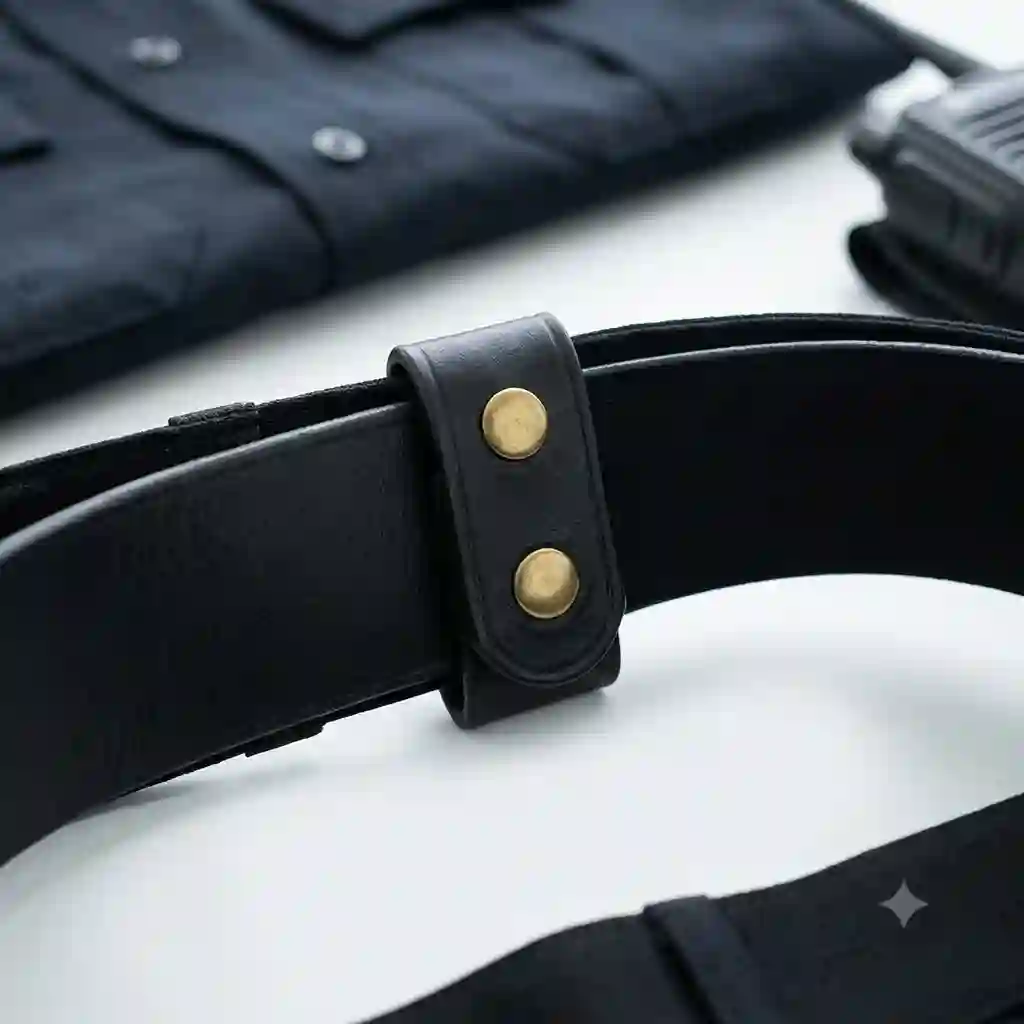
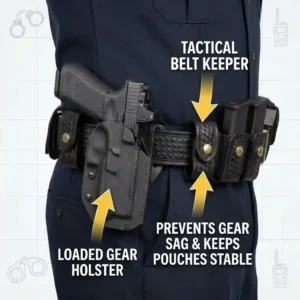
If you have ever spent a 12-hour shift getting in and out of a patrol cruiser, you know that a fully loaded duty rig is a literal pain in the lower back. Between your firearm, magazines, radio, baton, and cuffs, you are easily carrying 15 to 20 pounds of equipment around your waist. Without a reliable belt keeper system, that outer rig shifts, slides, and eventually pulls your duty pants down, throwing your entire musculoskeletal alignment out of balance.
What is a belt keeper? In simple terms, it is a small, looped strap—usually made of leather, ballistic nylon, or polymer—that wraps around both your inner trouser belt and your heavy outer duty belt, snapping shut to lock the two together. But speaking from over ten years of field experience, I can tell you that treating these as a mere afterthought is a massive mistake. A failing snap during a foot pursuit doesn’t just mean your gear shifts; it means your muscle memory is compromised when you reach for your retention holster under stress.
In this comprehensive guide, we are going to dive deep into the specific engineering, material sciences, and daily tactical realities of these unsung heroes. I’ll share my first-hand experience regarding what works, what frays after a month, and why spending an extra ten dollars on your foundation might just save you hundreds in physical therapy bills later.
Quick Comparison: Top Choices for 2026
When evaluating options on the market, you need to balance durability, snap retention strength, and department compliance. Here is a rapid breakdown of the top performers I have tested in the field.
| Brand & Model | Material | Snap Type | Best For | Price Range |
| Safariland 65 | Safarilaminate | Hidden Brass | Uniformity & Scratch Prevention | $15 – $25 |
| Bianchi 7311 | Ballistic Nylon | Dual Standard | Lightweight Tactical Rigs | Under $20 |
| Zak Tool ZT54 | Aluminum/Polymer | Push-Button | Heavy Gear & Key Holding | $10 – $15 |
| Aker Leather 510 | Premium Cowhide | Solid Brass | Traditional Leather Rigs | $20 – $30 |
| Uncle Mike’s Mirage | Webbed Nylon | Standard | Strict Budget / Reserves | Under $15 |
While the table gives you a snapshot, the devil is in the details. The Safariland model dominates for patrol officers because the hidden snaps prevent steering wheel scratches, whereas the Zak Tool hybrid is a lifesaver for correctional officers who need to hang heavy key rings. Budget buyers often grab the Uncle Mike’s, but in practice, you sacrifice long-term rigidity for that lower upfront cost.
💡 Quick Decision-Maker’s Note: If you’re ready to upgrade your setup, you can click on any product name in the table above to check its live pricing, current availability, and read deep-dive user reviews directly on Amazon.
[addtoany]
Top 5 Picks: Expert Analysis and Field Testing
Here is the unfiltered truth about the top models available this year. I didn’t just read the spec sheets; I wore these on 12-hour shifts, in the rain, and through rigorous defensive tactics training.
1. Safariland 65 Duty Belt Keeper
The Safariland 65 is constructed from the brand’s proprietary Safarilaminate material and features hidden snaps. When a manufacturer claims a product has “hidden snaps,” they mean the metal closure mechanism does not protrude through the outer layer of the material. In daily use, this is a massive advantage. Exposed metal snaps consistently scrape against the steering wheels of patrol vehicles or snag on seatbelts when you quickly exit a cruiser.
In my field tests, the Safarilaminate material proved incredibly resistant to weather. Unlike traditional leather that absorbs moisture and swells in heavy rain, this synthetic blend wipes dry in seconds. The hidden snap design does make it slightly stiffer out of the box, meaning you will need a bit of thumb strength to snap them closed during your first week. I highly recommend these for patrol officers whose department Standard Operating Procedures (SOPs) mandate a basketweave or plain black finish.
Most reviewers claim these are the undisputed industry standard, and in practice, I found that reputation to be well-earned. They typically sit in the $15 to $25 range for a pack of four, offering excellent value. Community feedback frequently praises their longevity, noting that the snaps remain crisp and secure even after two years of daily snapping and unsnapping.
2. Bianchi 7311 AccuMold
Constructed with high-density ballistic nylon and featuring dual snaps, the Bianchi 7311 is engineered for lightweight flexibility. The “AccuMold” specification isn’t just marketing jargon; it refers to a heat-molding process that pre-curves the nylon to match the natural radius of a human waist. This means the keeper sits flush against your body immediately, completely eliminating the break-in period required by leather alternatives.
What surprised me most during use was how well these paired with modern, MOLLE-style outer belts. Because they are lightweight and contoured, they don’t add unnecessary bulk to an already crowded waistline. However, if you run a very thick leather outer belt, the AccuMold curvature can occasionally feel a bit tight. I recommend these primarily for tactical units, private security, or anyone utilizing a full-nylon lightweight rig.
Priced comfortably under $20 for a set, they deliver a fantastic return on investment. Actual community feedback highlights their fade resistance; while cheaper nylon turns a dull purple after a summer in the sun, the Bianchi holds its deep black dye. They strike the perfect balance between modern synthetic materials and classic retention strength.
3. Zak Tool ZT54 Tactical Hybrid
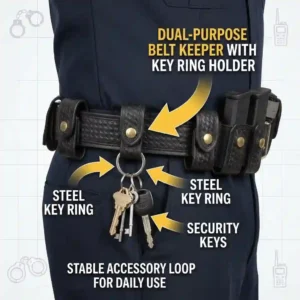
The Zak Tool ZT54 breaks the traditional mold by utilizing a blend of high-strength polymer and an aluminum push-button clasp. Instead of relying on traditional friction snaps, it uses a mechanical lock that doubles as a tactical key ring holder. This means you can hang your heavy chits, handcuff keys, or patrol vehicle fobs directly on the strap itself without needing an additional key hook on your belt.
In my experience, this mechanical design solves a major pain point for correctional officers and jailers who carry massive key clusters. Traditional leather snaps can pop open under the weight of heavy keys when running, but the ZT54’s push-button lock remains completely secure until you manually release it. The downside? It is rigid. If you position it directly over your hip bone, it will dig in when you sit.
Hovering in the $10 to $15 range per piece (they are often sold individually rather than in 4-packs), this is a specialized tool rather than a generic accessory. Real-world buyers rave about its sheer indestructible nature, though some note it takes up slightly more horizontal belt space than a standard strap. If you need maximum security and a place to hang gear, this is your best bet.
4. Aker Leather 510 Double Snap
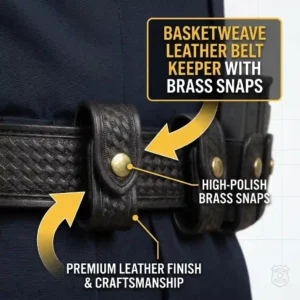
For traditionalists, the Aker Leather 510 is crafted from premium, vegetable-tanned US cowhide and utilizes heavy-duty solid brass snaps. When you see “vegetable-tanned” on a spec sheet, it means the leather was cured using natural tannins, resulting in a denser, thicker hide that resists stretching under the downward pull of a loaded duty rig.
If you are required to wear a high-gloss or classic basketweave leather duty belt (such as the classic Sam Browne setup detailed on Wikipedia’s law enforcement portal), mixing synthetic nylon keepers into your rig looks unprofessional. The Aker 510 is for the old-school officer. Keep in mind, what most buyers overlook is the break-in period. During the first two weeks, you will struggle to get both snaps closed over a thick belt. You need to condition them with a bit of leather oil and give them time to stretch.
Priced in the $20 to $30 range for a pack of four, they are an investment in longevity. The community feedback consistently points to their incredible lifespan; I’ve seen officers use the exact same set of Aker straps for over a decade. The brass snaps will develop a natural patina over time, but a quick polish brings them right back to inspection-ready standards.
5. Uncle Mike’s Mirage
The Uncle Mike’s Mirage model utilizes a webbed nylon construction with standard black-coated snaps. The “Mirage” finish is designed to mimic the look of leather without the associated weight or cost, making it a highly accessible entry-level option. At its core, this is a minimalist strap designed to do one job without any extra frills.
In my field tests, I found these to be perfectly adequate for reserve officers, event security staff, or anyone who doesn’t wear a duty belt 40 hours a week. However, the webbed nylon lacks internal rigidity. If you carry a heavy loadout, the nylon edges will begin to curl and fray after about six months of heavy friction against your vehicle seats. The snaps also tend to lose their crisp “click” faster than the premium brass options.
Sitting well under $15 for a set, they are undeniably budget-friendly. Community feedback is mixed; users love the price and the lightweight feel, but veteran officers quickly point out that they need to be replaced annually. If you are just graduating from the academy and need gear on a tight budget, these will get you through your first year on patrol.
🔍 Ready to Upgrade Your Tactical Setup?
If your current rig is causing lower back pain or your pouches keep shifting during foot patrols, it is time to reassess your foundation. Click on our recommended models below to view current pricing and find the perfect fit for your daily routine on Amazon.
Practical Usage Guide: The 4-Point Setup Strategy
Simply buying a quality belt keeper set is only half the battle; how you deploy them determines your physical comfort. A common mistake rookies make is placing all their straps in the front, leaving the back of the heavy duty belt unsupported. This directly contributes to lower lumbar fatigue, an issue heavily documented by the National Institute of Justice regarding officer load-bearing stress.
The Setup Sequence:
-
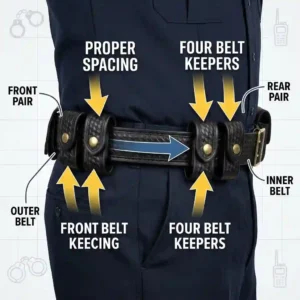
The Anchor Points: Place your first two straps immediately behind your hip bones (approximately the 4 o’clock and 8 o’clock positions). This locks your heavy firearm and your radio/cuff pouches securely against your center of gravity.
-
The Front Stabilizers: Place the remaining two straps in the front, about two inches left and right of your main belt buckle (the 11 o’clock and 1 o’clock positions).
-
The Interlock Technique: Always thread the strap underneath your inner trouser belt first, then fold it over the top of the outer rig. This ensures gravity is working with the snaps, not against them.
By following this 4-point distribution, you create a halo effect that transfers the 15-pound load off your lower spine and distributes it evenly across your hips.
Problem Solving: When Gear Shifts and Snaps Fail
If your current setup is failing, it is rarely the fault of a single component, but rather a systemic issue with how your gear integrates. Let’s look at the most common problems I encounter when consulting with security teams, and how to fix them.
Problem 1: The Sliding Holster
Even with a tightly woven inner belt, a heavy Level III retention holster can slide forward when you run.
The Solution: Use a belt keeper as a physical barricade. Snap one tightly right in front of your holster loop and another directly behind it. This creates a “cage” that prevents the holster from sliding along the belt’s axis.
Problem 2: The “Popping” Snap
If your snaps constantly burst open when you sit down, you are likely suffering from thickness incompatibility.
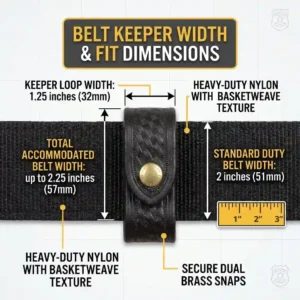
The Solution: Standard straps are designed for a combined thickness of about 0.5 inches (inner plus outer belt). If you use a padded inner belt and a thick leather outer rig, you are exceeding the snap’s tolerance. You must switch to an extended-length strap (look for models labeled “XL” or “Dual Duty”) or switch to a push-button mechanical closure like the Zak Tool model.
How to Choose the Right Rig Attachment
When evaluating a belt keeper, the spec sheet only tells you so much. Here is my expert framework for choosing the exact right model for your specific uniform requirements.
-
Match Your Finishes: Never mix a high-gloss outer rig with matte nylon attachments. It looks incredibly sloppy and violates most department uniform codes. If your gear is basketweave leather, buy basketweave attachments.
-
Width Matters: Standard straps come in 3/4-inch and 1-inch widths. If your duty rig is crowded with a Taser, double cuffs, radio, OC spray, and a baton, belt real estate is premium. Opt for the narrower 3/4-inch models to squeeze them between your pouches.
-
Hardware Selection: Brass snaps are traditional and incredibly durable, but they oxidize (turn green) if exposed to sweat and not cleaned. Polymer or hidden metal snaps require zero maintenance, making them vastly superior for humid, maritime, or rainy environments.
Common Mistakes When Buying Duty Gear Accessories
The most frequent error I see is buying cheap, single-snap models. A single snap creates a pivot point. If it gets caught on a seatbelt, it simply rotates and pops open. Dual-snap models (where there are two distinct metal closures on each strap) distribute the tension.
Another critical mistake is failing to replace them when they wear out. I have seen officers walking around with broken straps, holding their rig together with black electrical tape. A stretched-out strap allows your heavy outer rig to sag up to two inches below your inner belt. This sagging alters the height of your firearm by two inches. If you are forced to draw your weapon in a high-stress scenario, your muscle memory will reach for a grip that is no longer where your brain expects it to be.
Material Showdown: Leather vs. Nylon vs. Polymer
Understanding the biology of wear and tear helps justify your purchase.
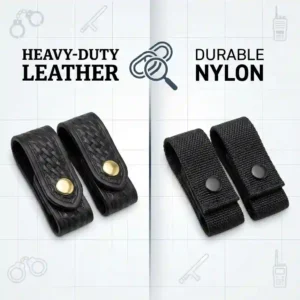
Premium Leather: Leather is essentially skin; it expands, contracts, and requires hydration. A good leather strap will outlast your career if you hit it with saddle soap once a month. However, if left to dry rot in a hot car, it becomes brittle and the snaps will tear right through the hide.
Ballistic Nylon: Originally developed for flak jackets, ballistic nylon is impervious to rot and requires zero maintenance. The downside is edge fraying. Over thousands of repetitions of rubbing against a nylon seat, the edges will fuzzy and fray. You can easily fix this by passing a lighter flame over the frayed edges to melt the nylon fibers back together.
Polymer/Synthetic Laminates: Materials like Safarilaminate are the ultimate modern compromise. They look like leather but act like plastic. They don’t absorb blood-borne pathogens (a major consideration in modern law enforcement, heavily discussed on platforms like Police1), they wipe clean with a Clorox wipe, and they never lose their structural rigidity.
What to Expect: Real-World Performance Over 12 Months
Providing a roadmap for what happens to your gear over a year of daily use sets realistic expectations.
Month 1 to 3 (The Break-In): If you bought leather or stiff laminates, expect a thumb workout. You will curse how hard they are to snap. By month three, the material will have micro-creased exactly where it folds over your rig, and snapping them becomes a smooth, one-handed operation.
Month 6 (The Stress Test): By month six, you will notice if you bought a cheap product. Budget nylon models will start to lose their shape, curling at the edges. You may also notice the black paint chipping off exposed metal snaps, revealing the brass or steel underneath.
Month 12 (The Evaluation): At the one-year mark, evaluate your snap retention. Do they pull apart easily when you tug on them? If so, the internal spring mechanism inside the female side of the snap has fatigued. It is time to replace them. For under $25, rotating fresh gear into your rig annually is a negligible cost for guaranteed security.
The Anti-Recommendation: Who Shouldn’t Buy Standard Keepers
For all my praise of these accessories, they are actually a bad fit for a specific demographic: undercover officers, plainclothes investigators, and competition shooters.
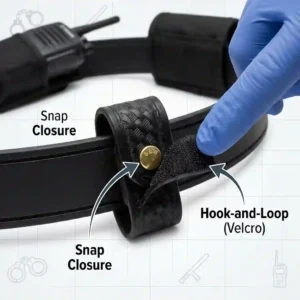
If you utilize a modern “Velcro inner/outer system”—where the inner trouser belt is covered in loop material and the outer tactical rig is covered in hook material—you generally do not need traditional snap straps. The entire surface area of the two belts bonds together. Adding bulky straps over a hook-and-loop system just adds unnecessary weight and creates pressure points under a concealed carry garment. In these highly specific edge cases, traditional snaps are obsolete.
Conclusion
Securing your duty rig is not just about looking sharp for inspection; it is a fundamental aspect of officer safety, ergonomic health, and tactical readiness. A high-quality belt keeper prevents your 15-pound loadout from shifting during critical moments and protects your lower spine from the slow, grinding fatigue of unbalanced weight.
Whether you opt for the steering-wheel-saving hidden snaps of the Safariland 65, the old-school aesthetic of the Aker Leather 510, or the modern mechanical retention of the Zak Tool ZT54, remember that your foundation dictates your performance. Don’t let a failing $5 piece of nylon be the reason you can’t reach your gear when seconds count. Invest in quality, configure them properly around your waist, and inspect your snaps regularly.
FAQs
❓ What is a belt keeper used for on a duty rig?
✅ It is used to anchor a heavy outer duty rig directly to an inner trouser belt. This prevents equipment from sagging, sliding, or completely falling off during physical altercations or foot pursuits, ensuring your gear remains exactly where your muscle memory expects it to be…
❓ How many should I wear on my duty belt?
✅ The standard protocol is four. You should place two in the front (spaced evenly near the buckle) and two in the back (behind the hip bones). This four-point configuration perfectly balances the heavy weight of a firearm and radio across your pelvis…
❓ Can you wash nylon duty accessories?
✅ Yes, you can clean ballistic nylon with mild dish soap and warm water. Use a soft-bristled brush to remove dried mud or debris, then let them air dry. Do not put them in a washing machine, as the metal snaps can damage your appliance…
❓ Why do my duty belt snaps keep coming undone?
✅ This usually happens for two reasons: either the internal spring in the snap is worn out from age, or your combined belts are too thick for the strap. If you use a thickly padded rig, you must upgrade to an extra-long model to reduce snap tension…
❓ Are hidden snaps better than exposed snaps?
✅ For patrol vehicle use, yes. Hidden snaps are covered by a layer of leather or laminate, meaning there is no exposed metal. This entirely prevents you from accidentally scratching your cruiser’s steering wheel or tearing the fabric of the driver’s seat when exiting…
Recommended for You
- 5 Best duty belt accessories to Upgrade Your Tactical Rig in 2026
- The 5 Best Leather Police Duty Belt Options for 2026: Expert Duty Rig Guide
- 5 Best Duty belt keepers of 2026 for Unmatched Gear Stability
Disclaimer: This article contains affiliate links. As an Amazon Associate, I earn from qualifying purchases. If you purchase products through these links, we may earn a small commission at no additional cost to you.
✨ Found this guide helpful? Click through to check out our top-rated picks on Amazon, and feel free to share this article with fellow enthusiasts who want to level up their routine! 💬🤗
[addtoany]
