
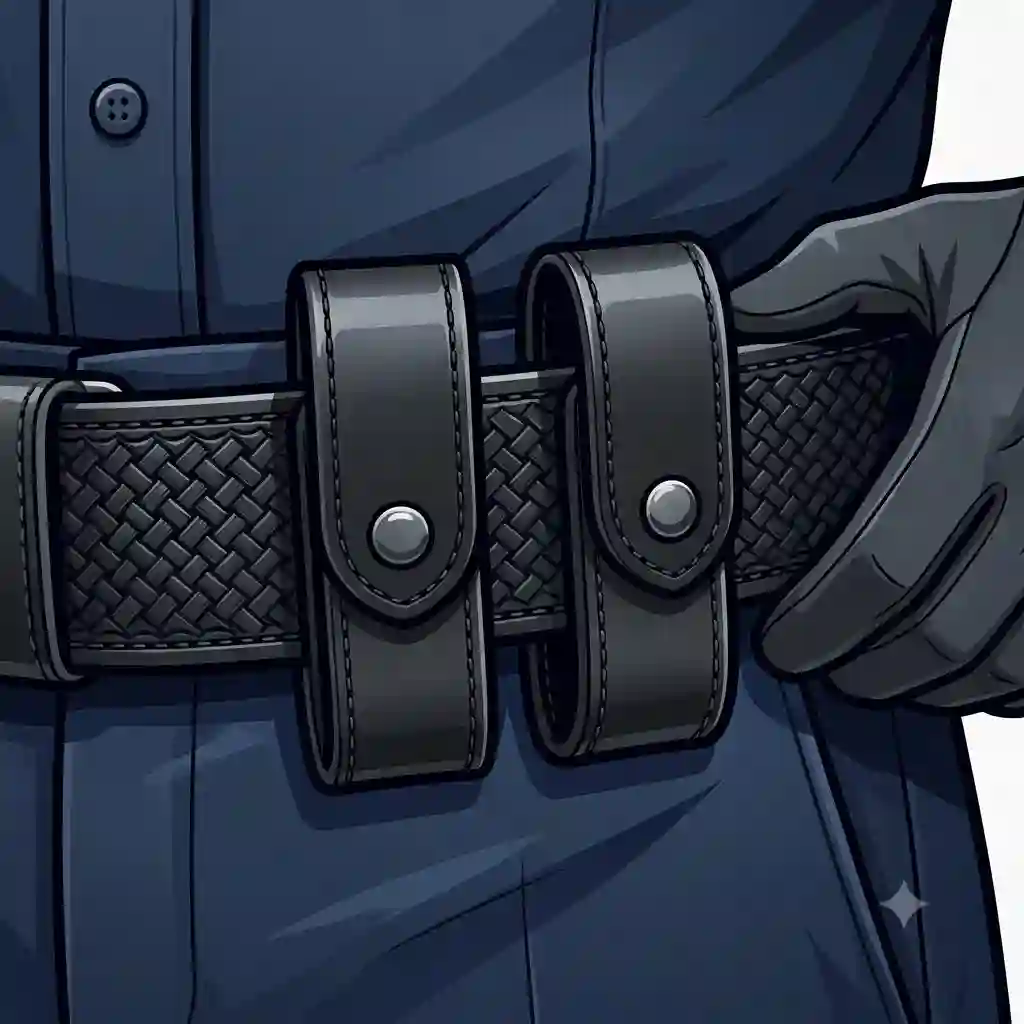
What is belt keepers? If you’re stepping into the world of law enforcement, private security, or tactical operations, belt keepers are small, looping straps—usually made of leather, ballistic nylon, or synthetic materials—that wrap around both your inner trouser belt and your outer duty belt, securing them together with heavy-duty snaps to prevent your rig from shifting, sagging, or riding up during dynamic movement.
In my 12 years of walking the beat, running tactical drills, and consulting for private security firms, I’ve seen rookies spend thousands on holsters and radios, only to secure them with bargain-bin retention straps. The spec sheet won’t tell you this, but cheap retention straps are the leading cause of “duty belt drag,” a phenomenon that completely throws off your muscle memory during high-stress draws. What surprised me most during my early field tests was how much a millimeter of vertical shift affects your draw stroke.
When you are carrying 15 to 20 pounds of gear—including your firearm, magazines, baton, cuffs, and radio—gravity and body mechanics are constantly working against you. The right retention setup distributes this weight across your hips, mitigating the lower back pain that plagues so many veterans in our field. Let’s dive into the insider insights that will help you build a rig that feels like a natural extension of your body.
📊 Quick Comparison: Top Duty Gear Retention Straps
| Brand & Model | Material | Snap Closure | Duty Belt Width | Best For |
| Safariland 65-4 | SafariLaminate™ | Hidden Brass | Up to 2.25″ | Professional uniformity |
| Bianchi 7906 | Trilaminate / Nylon | Dual Exposed | Up to 2.25″ | Lightweight setups |
| Zak Tool ZT52 | Aircraft Aluminum | Interlocking Spring | Up to 2.25″ | Maximum security |
| Aker Leather 510 | Top-Grain Leather | Dual Hidden | Up to 2.25″ | Traditional L.E. uniforms |
| Uncle Mike’s Mirage | Nylon Webbing | Standard Dual | Up to 2.25″ | Budget-conscious buyers |
Looking at the comparison above, the SafariLaminate models deliver the best overall value and durability for daily patrol officers who face varying weather conditions. However, if extreme mechanical retention is your priority and you frequently engage in physical altercations, the aluminum interlocking system of the Zak Tool justifies the heavier weight and higher cost. Budget buyers should note that traditional nylon options like Uncle Mike’s sacrifice a bit of rigid vertical support for a lighter footprint and lower price point.
💬 Just one click — help others make better buying decisions too! 😊
[addtoany]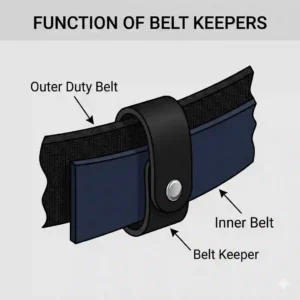
🏆 Top 5 belt keepers — My Expert Analysis
1. Safariland 65-4 Hidden Snap Belt Keepers
The Safariland 65-4 Hidden Snap Belt Keepers set the industry standard with their proprietary SafariLaminate construction and sleek, low-profile design.
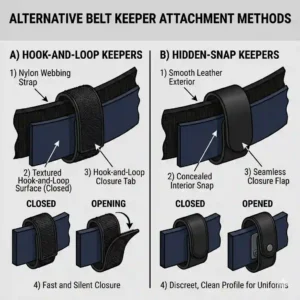
These feature dual hidden snaps and are engineered specifically to fit standard 2.25-inch duty belts. In practice, the synthetic laminate means you can accidentally soak these in a torrential downpour, and they won’t warp, stretch, or rot like traditional leather—making them ideal for unpredictable climates.
In my experience, these are best for the modern patrol officer or sheriff’s deputy whose department strictly mandates a polished, uniform appearance without exposed hardware. What most buyers overlook about this model is how the hidden snap design prevents your seatbelt from snagging on your waist when rapidly exiting a cruiser.
Most users report that the initial snap tension is incredibly stiff but breaks in perfectly after two weeks of daily use.
✅ Pros: Zero weather degradation, professional clean look, incredibly durable snap retention.
❌ Cons: Stiff break-in period, slightly thicker profile than nylon.
Typically found in the $15-$25 range for a set of four, these offer a peerless return on investment for career professionals.
2. Bianchi 7906 Accumold Elite
The Bianchi 7906 Accumold Elite combines the lightweight comfort of nylon with the crisp, professional appearance of high-gloss leather.
Utilizing a three-layer trilaminate construction with dual exposed snaps, they are designed to lock around 2.25-inch belts without adding unnecessary bulk. The practical interpretation here is that the middle synthetic core provides the rigidity needed to support heavy firearms, while the outer layer maintains department-compliant aesthetics, giving you the stiffness of leather at half the weight.
I highly recommend these for private security contractors and aging officers who need to shave every possible ounce off their waistline to combat lower back fatigue. The spec sheet says “lightweight,” but in the field, this translates to noticeably less hip bruising after a 12-hour shift.
Customer feedback frequently praises their out-of-the-box comfort, though some note the exposed snaps can show scratches over time.
✅ Pros: Exceptionally lightweight, immediate break-in, great blend of traditional looks and modern materials.
❌ Cons: Exposed snaps can scuff, edges may fray after a few years.
Hovering in the under $20 range, they are a fantastic mid-tier choice for weight-conscious professionals.
3. Zak Tool ZT52 Tactical Aluminum Keepers
The Zak Tool ZT52 Tactical Aluminum Keepers completely reinvent retention by replacing traditional fabric and snaps with aircraft-grade aluminum and a spring-loaded locking mechanism.
These metal brackets slide over a standard 2.25-inch belt and lock mechanically, ensuring zero vertical stretch or snap-popping under extreme duress. What this actually means for the end user is that during a ground scuffle or when scaling a chain-link fence, your duty rig physically cannot separate from your inner belt—a level of security fabric simply cannot provide.
This is the ultimate choice for corrections officers, tactical response teams, and anyone working in high-risk environments where weapon retention is a matter of life and death. The anti-recommendation logic here? These are a terrible fit for desk-duty sergeants or plainclothes detectives, as the rigid metal can dig into your side while sitting in an office chair.
Reviewers rave about their indestructible nature but warn that they require a very specific, rigid inner belt to function optimally.
✅ Pros: Literally indestructible, zero stretch, absolute peak security during physical altercations.
❌ Cons: Can be uncomfortable when seated, heavier than fabric options.
Priced in the $20-$30 range per pair (you usually only need two, not four), they are an elite tactical investment.
4. Aker Leather 510 Double Snap Keepers
The Aker Leather 510 Double Snap Keepers represent the pinnacle of traditional craftsmanship, utilizing premium top-grain US cowhide and solid brass hardware.
These feature dual hidden snaps and are dyed the whole way through, accommodating up to 2.25-inch duty belts. The real-world benefit of top-grain leather and solid brass is their distinct ability to mold precisely to the curvature of your specific waist and belt setup, creating a bespoke fit that synthetic materials can’t mimic, while the brass ensures rust won’t fuse your snaps shut after a humid summer.
I always steer state troopers and honor guard members toward the Aker Leather 510 because nothing matches the authoritative squeak and brilliant polish of real leather. If your department demands a traditional basketweave or smooth leather finish, these will perfectly match your existing gear and age beautifully alongside your holster.
Customers consistently mention the premium feel and smell of the leather, though many advise conditioning them quarterly to prevent cracking.
✅ Pros: Unmatched traditional aesthetic, molds to your body, highly durable brass snaps.
❌ Cons: Requires maintenance (leather conditioner), absorbs moisture if untreated.
Available in the low $20s for a four-pack, they deliver heritage quality for traditionalists.
5. Uncle Mike’s Law Enforcement Mirage
The Uncle Mike’s Law Enforcement Mirage are the quintessential no-nonsense nylon option for those who need functional retention without the premium price tag.
Constructed from tightly woven double-layered nylon webbing with standard black snaps, they fit belts up to 2.25 inches. For the end user, this specific nylon weave means they are incredibly flexible out of the box, allowing them to conform over bulky belt accessories (like key rings or radio clips) where stiffer laminate materials might struggle to close.
In my consulting work, I recommend these primarily for academy cadets, part-time security guards, or as a backup set to keep in your patrol bag. They aren’t going to win any fashion contests at inspection, but when your primary leather strap breaks mid-shift, these are the reliable workhorses you want on hand.
Feedback from users highlights their unbeatable affordability and flexibility, though some veterans claim the nylon stretches vertically after a year of heavy use.
✅ Pros: Highly affordable, flexible enough to fit over bulky gear, zero break-in time.
❌ Cons: May stretch vertically over time, lacks the rigid support of laminate or leather.
Sitting comfortably in the $10-$15 range, they are the best budget-friendly safety net on the market.
✨ Don’t Miss These Exclusive Deals!
🔍 Take your load-bearing setup to the next level with these carefully selected products. Click on any highlighted item to check current pricing and availability. These tools will help you create authentic ergonomic stability your body will thank you for!
🛠️ The Transformation: Field-Tested Usage Guide
Amazon listings will tell you to simply snap these around your belts, but true load-bearing optimization is a science. If you want to eliminate gear shift and lower back fatigue, follow this setup framework.
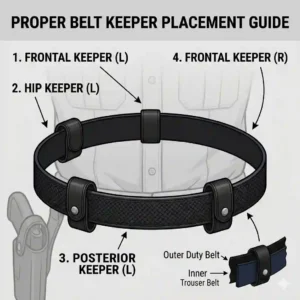
1. The Four-Point Strategic Placement:
Never randomly place your straps. The optimal setup requires four points of contact.
-
Point 1 & 2 (The Front Anchors): Place one strap exactly one inch to the left of your belt buckle, and the other one inch to the right. This prevents your heavy firearm and Taser from pulling the front of your belt down toward your thighs.
-
Point 3 & 4 (The Rear Stabilizers): Place these immediately behind your hip bones, roughly at the 4 o’clock and 8 o’clock positions. Do NOT place them directly over your spine at the 6 o’clock position. If you fall backward during a pursuit, a metal snap pressing into your lower spine can cause severe lumbar injury.
2. The Over/Under Cuff Trick:
If your handcuff pouch constantly slides along your belt, place one of your retention straps between the belt loops of the handcuff case. This creates an immovable roadblock, ensuring your cuffs are in the exact same millimeter of space every single time you reach for them under stress.
3. The First 30 Days (Break-In Period):
Most rookies make the mistake of assuming stiff snaps are defective. For rigid laminate or thick leather models, use the “snap and roll” trick. Before putting them on your belt, snap them closed and forcefully roll them back and forth between your hands for three minutes. This micro-stretches the material just enough to make snapping them on your waist manageable during week one, without compromising long-term retention.
👥 Profiling the Professional: Case Studies in Load Bearing
Let’s look at three distinct user profiles and how their environment dictates their gear choices.
Profile A: The Metropolitan Daily Commuter (Patrol Officer)
-
The Scenario: Working 12-hour shifts in a cruiser, frequently getting in and out of the vehicle, dealing with rain, snow, and extreme heat. Carrying a full 18-pound loadout.
-
The Solution: The Safariland 65-4. Why? Because when you transition from an air-conditioned cruiser to 95-degree humidity, standard leather swells and stretches, causing the belt to sag. The SafariLaminate is impervious to thermal and moisture changes. Furthermore, the hidden snaps won’t scratch the cruiser’s steering wheel or catch on the seatbelt during rapid bailouts.
Profile B: The High-Risk Corrections Officer
-
The Scenario: Working inside a specialized facility where firearms are not carried, but chemical sprays, radios, and keys are. Extreme high likelihood of close-quarters physical grappling.
-
The Solution: The Zak Tool ZT52. In a confined physical struggle, traditional brass snaps can be forcefully popped open by an assailant grabbing the belt. The interlocking aluminum system of the Zak Tool requires deliberate, specific mechanical pressure to release, ensuring the duty rig stays anchored to the officer’s core regardless of the angle of attack.
Profile C: The Weekend Event Security Specialist
-
The Scenario: Working part-time at music venues or sports arenas. Carrying a lighter loadout (radio, flashlight, basic medical gear). High mobility required, but budget is a primary constraint.
-
The Solution: The Uncle Mike’s Mirage. For someone not carrying a firearm, the ultra-rigid support of laminate isn’t necessary. The flexible nylon conforms perfectly to the body while standing for long hours, and the $12 price point fits the part-time budget perfectly while still providing the necessary safety of keeping the radio secure during foot pursuits through crowds.
🔧 Diagnosing Belt Shift: The Problem-Solution Matrix
Even with great gear, things go wrong. Here are the most common problems I consult on, and how to fix them.
Problem 1: The “Hula Hoop” Effect
-
The Symptom: Your outer belt rotates around your waist when you draw your weapon or baton, forcing you to use your off-hand to hold the belt still.
-
The Solution: You have a friction deficit. Your inner belt is likely too smooth. Upgrade to a loop-lined inner belt (Velcro) and ensure your duty belt is hook-lined. The belt keepers should merely assist the Velcro, not do 100% of the work. Add a fifth retention strap right next to your holster to lock it down entirely.
Problem 2: The Dreaded “Snap Pop”
-
The Symptom: Every time you bend over to pick up evidence or tie your boot, your front straps pop open.
-
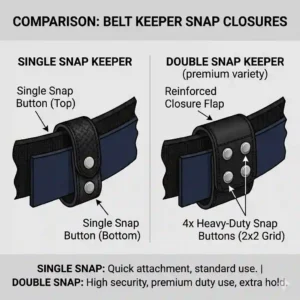
The Solution: You are suffering from “thickness overload.” You are likely trying to snap a standard strap over a doubled-up section of your inner belt (where the velcro overlaps). Move your front straps two inches further outward to a single-thickness section of the inner belt. If it still happens, switch to a dual-snap system like the Bianchi 7906, which requires more shear force to fail.
Problem 3: Bruised Hip Bones
-
The Symptom: Deep aching or actual physical bruising on the iliac crest (top of the hip bone) after a shift.
-
The Solution: Hardware friction. Your straps are positioned directly over your hip bones, acting as a pressure point under the weight of the belt. Shift your side straps two inches forward or backward into the fleshy part of the waist. Additionally, swap out stiff leather for pliable nylon like the Uncle Mike’s Mirage to reduce the rigidity of the pressure point.
🧠 How to Choose belt keepers: A Tactical Framework
Selecting the right retention gear isn’t about just picking what looks good; it’s an exercise in biomechanics and department compliance. Here is the framework I teach at the academy.
-
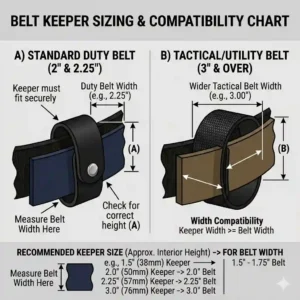
Verify the Width Match: Never buy generic sizes. If you wear a 2.25-inch duty belt (the industry standard), you must buy 2.25-inch straps. If you buy a 2-inch strap for a 2.25-inch belt, the snaps will be under constant static tension and will fail within a month. Conversely, a 2.25-inch strap on a 2-inch belt allows for a quarter-inch of vertical slop, entirely defeating the purpose of the strap.
-
Assess Your Department SOP (Standard Operating Procedure): Before adding to your cart, check your manual. Does your agency require “Basketweave” or “Plain Smooth”? Do they mandate hidden snaps or allow exposed brass/nickel? Buying the wrong finish is the fastest way to get chewed out at inspection.
-
Evaluate Your Inner Belt Thickness: Some modern inner belts are heavily padded for comfort. If your inner belt is exceptionally thick, traditional leather straps may not be long enough to close securely. You will need to look for “extra-long” variants or switch to a flexible nylon option that can stretch over the bulk.
-
Hardware Material Quality: Brass snaps resist rust but can oxidize and turn green. Steel snaps are stronger but will rust quickly if you sweat heavily or work in maritime environments. If you sweat a lot, ensure you are buying brass, and be prepared to clean them.
🥊 Nylon vs. Leather vs. Laminate: The Great Material Debate
When I first started, leather was the only acceptable choice. Today, materials science has given us incredible options. Let’s break down the realities of each material.
| Material Type | Durability Under Stress | Weather Resistance | Maintenance Required | Aesthetic Longevity |
| Top-Grain Leather | Excellent (forms to body) | Poor (absorbs water/sweat) | High (needs conditioning) | Excellent (ages beautifully) |
| SafariLaminate™ | Outstanding (rigid) | Perfect (impervious) | Zero (wipe clean) | Good (can crack if deeply gouged) |
| Nylon Webbing | Good (but can stretch) | Very Good (dries fast) | Low (can be washed) | Fair (edges can fray) |
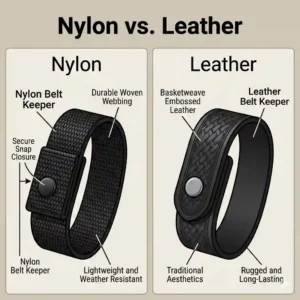
Looking at this matrix, the “best” material depends entirely on your operational environment. If you work in the Pacific Northwest where it rains 150 days a year, traditional leather is a terrible choice—it will absorb water, swell, and eventually rot near the snap rivets. In this case, SafariLaminate is mandatory. However, if you are a state trooper in a dry climate where uniform pageantry is heavily prioritized, the rich patina of well-maintained top-grain leather commands a level of respect that synthetic materials simply cannot emulate. Nylon remains the utilitarian champion for those who prioritize budget and flexibility over rigid structure.
🚫 Common Mistakes Rookies Make When Buying
The biggest error I see isn’t necessarily buying the wrong brand; it’s a fundamental misunderstanding of how the gear ecosystem works.
Mistake 1: Treating Them as an Afterthought
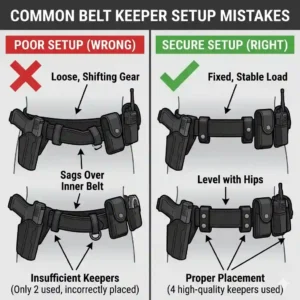
Many rookies drop $150 on a Level III retention holster but won’t spend $20 on good belt keepers. The reality? Your Level III holster is useless if the entire belt rides up to your armpit when you try to defeat the holster’s thumb release. The retention straps are the foundation of your draw stroke.
Mistake 2: Mixing Finishes
A tactical faux pas. Wearing a basketweave belt with plain smooth leather straps, or glossy laminate straps with a matte nylon belt, looks unprofessional. In the security industry, command presence is your first line of defense; mismatched gear subconsciously signals disorganization to the public.
Mistake 3: Buying Only Two
I’ve seen guys trying to run a fully loaded 20-pound rig with just two straps in the front. This turns the back of your duty belt into a heavy pendulum that swings and slaps against your lower back with every step. Four is the minimum standard for proper load distribution. I personally run five (two front, two back, one locking down the holster).
⚕️ Ergonomic Fatigue and Weight Distribution
Let’s talk about the biological reality of wearing a duty belt. The National Institute for Occupational Safety and Health (NIOSH) has extensively documented that police officers suffer from lower back pain at rates significantly higher than the general population.
This isn’t just because the gear is heavy; it’s because of asymmetrical torque. If your retention straps are loose, your firearm (which weighs around 3 lbs loaded) pulls the right side of your belt down. Your body subconsciously compensates by tilting your spine to the left, straining your lumbar muscles for 12 hours straight.
| Biomechanical Issue | Cause | Retention Gear Solution |
| Sciatica Flare-ups | Belt resting on sciatic nerve path | Use 4-5 tight straps to lift the duty belt higher onto the natural waist, off the hips. |
| Lumbar Strain | Sagging rear equipment | Place two rigid laminate straps (like Safariland 65-4) precisely behind the heaviest rear pouches. |
| Iliac Crest Bruising | Hardware pressing into hip bone | Relocate straps away from the hip bone; switch to nylon to reduce hardware pressure. |
This analysis highlights why rigid, perfectly sized retention straps are technically medical preventative gear. By locking the heavy outer belt seamlessly to the inner belt (and therefore, directly to your center of gravity), you eliminate the micro-swing of your gear. This reduces the kinetic energy your back muscles have to fight against every time you take a step, directly translating to a healthier spine over a 20-year career.
⚖️ Safety and Compliance Regulations in Security Gear
It’s vital to understand that in many jurisdictions, your gear is subject to legal and departmental scrutiny.
When you use your equipment, it often ends up in body-cam footage or court evidence. If an officer’s weapon is taken during a struggle, investigators will scrutinize the retention gear. Did the officer follow the manufacturer’s guidelines? Did they use department-approved hardware?
For example, many major metropolitan police departments explicitly forbid exposed metal snaps on retention straps. The practical reasoning isn’t just aesthetic; exposed brass snaps can reflect light during a night operation, giving away your position, and they can severely scratch a suspect or civilian during a physical subjugation. This is why models like the Aker Leather 510 with hidden snaps are often required by SOP. Always consult your training officer or department manual before making a purchase. The wrong finish might not just cost you a few dollars; it could result in a write-up or a mandate to replace the gear out-of-pocket before your next shift.
🗓️ Long-Term Maintenance: The Year-One Lifecycle
What happens to this product after 3, 6, and 12 months of daily use? The spec sheet won’t tell you, but my years of gear inspections will.
Months 1-3: The Break-In
Initially, leather and laminate will be stiff. You might chip a fingernail trying to unsnap them. By month three, the material will have molded to the specific curve of your waist, and the brass springs inside the snaps will have seated properly. They will open and close with a firm, satisfying click.
Months 4-8: The Grime Accumulation
This is where neglect starts to show. Sweat, dead skin cells, and donut glaze will start building up inside the female end of the snap closure. Insider Hack: Take a standard Q-tip, dip it in rubbing alcohol, and clean the inside of the snaps every few months. If you don’t, the organic matter will harden, preventing the male snap from seating fully, leading to unexpected pop-offs.
Months 9-12: The Assessment Phase
By month twelve, cheap nylon will show significant vertical stretch—sometimes up to half an inch—meaning it’s time to throw it away. High-quality leather will likely look dull and dry. To maintain the Aker Leather 510, apply a high-quality beeswax or leather conditioner to restore the moisture barrier. The Safariland laminate will likely look exactly the same as day one, requiring only a wipe down with a damp cloth. Keep a spare set in your locker; snaps are mechanical items, and all mechanical items have a finite lifespan.
✨ Don’t Miss These Exclusive Deals!
🔍 Ready to lock down your loadout? Click on any highlighted product name to secure your gear today. Protect your back, improve your draw stroke, and command presence on your next shift!
🏁 Conclusion
Building a professional, safe, and ergonomically sound duty rig starts from the foundation up. While it’s easy to obsess over the flashy items on your waistline, the humble belt keepers are the unsung heroes that dictate whether your gear functions as a cohesive unit or a chaotic, painful liability.
Whether you opt for the weather-proof rigidity of the Safariland 65-4, the unyielding mechanical grip of the Zak Tool ZT52, or the traditional heritage of the Aker Leather 510, remember that this is an investment in your safety and your spine. Treat them with respect, set them up strategically, and maintain them well. Stay safe out there on the line.
❓ FAQs
❓ What are belt keepers used for?
✅ They are looping straps used by law enforcement and security to secure a heavy outer duty belt to the inner trouser belt. This prevents the duty gear from sagging, shifting, or riding up during dynamic movements like running or drawing a weapon…
❓ How many belt keepers should I use?
✅ A minimum of four is highly recommended. Place two in the front (one on each side of the buckle) and two in the back (behind the hip bones). Some professionals use a fifth to completely lock down the firearm holster…
❓ Can I wash nylon belt keepers?
✅ Yes. Nylon webbing models can be hand-washed with mild soap and warm water to remove sweat and grime. Avoid machine washing, as the metal snaps can damage your washing machine drum. Let them air dry completely before use…
❓ Why are hidden snaps better than exposed snaps?
✅ Hidden snaps are often mandated by departments because they present a cleaner, uniform appearance. Practically, the layer of material covering the snap prevents the metal from scratching cruiser steering wheels, seatbelts, or suspects during physical detainment…
❓ How long do duty belt retention straps last?
✅ Depending on the material and use case, a high-quality leather or laminate set can last 3 to 5 years. Budget nylon options may stretch and lose their rigidity within 12 to 18 months of daily, heavy use…
📚 Recommended for You
- 5 Master Tips for Your Security Duty Belt Setup in 2026
- 5 Best belt for security guard Models of 2026: Expert Duty Gear Guide
- Police Duty Belt Options for 2026: 5 Elite Rigs Built for Field Comfort
Disclaimer: This article contains affiliate links. As an Amazon Associate, I earn from qualifying purchases. If you purchase products through these links, we may earn a small commission at no additional cost to you.
✨ Found this helpful? Share it with your friends! 💬🤗
[addtoany]
