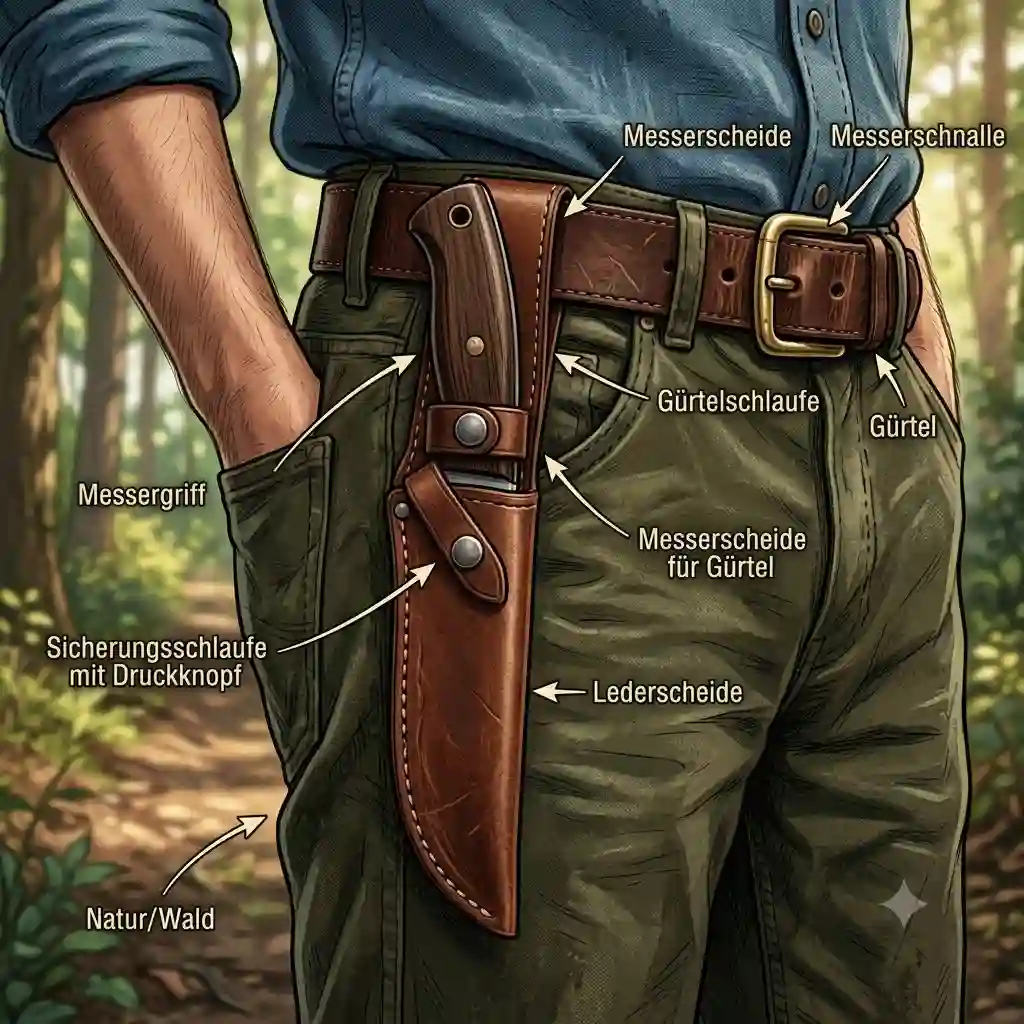
If you’ve spent any serious time carrying a fixed blade or a premium folder, you already know the frustrating truth: a world-class blade is effectively useless if the carry system fails. In my ten years of evaluating tactical gear and everyday carry (EDC) equipment, I’ve seen countless users invest hundreds of dollars in high-performance steel like S35VN or MagnaCut, only to slap it onto their waistline in a floppy, mass-produced nylon sleeve.
What is a knife sheath for belts? At its core, it is a structural housing designed to securely attach a bladed tool to your waist, providing instant accessibility while protecting the user from the edge, and the edge from environmental degradation. But that textbook definition misses the nuance of daily friction. A proper carry system must balance retention (keeping the blade secure during a dead sprint) with deployment speed.
When evaluating knife sheaths for belts, spec sheets reveal only part of the story. Marketing often highlights “premium leather” or “mil-spec hardware,” but not how materials perform after months of real use or how comfort changes during daily wear. Drawing from months of field testing in demanding environments, this guide cuts through the hype to reveal which models truly last, the real maintenance costs, the impact of draw angles, and why the best sheath depends entirely on your profession and intended use.
Quick Comparison: Top Knife Sheaths at a Glance
For those who need to make a rapid decision before their next shift or camping trip, here is how the top contenders stack up in the real world.
| Product Name | Material Type | Best Belt Fit | Carry Orientation | Standout Feature | Best For |
| Tale of Knives Multitool Flap Jax T-Tux | Full-Grain Leather | Up to 1.5″ | Vertical / Angled | Integrated EDC organizer slots | The “All-in-One” tradesman |
| Armatus Carry Architect | Kydex | Up to 1.75″ | Horizontal / Scout | Mil-spec Pull-the-Dot snaps | High-activity tactical use |
| Hide & Drink Leather Holder | Full-Grain Leather | Up to 2.0″ | Vertical | Rustic, single-piece cut | Budget-conscious minimalists |
| Nite Ize Tool Holster Stretch | Ballistic Nylon | Up to 2.3″ | 360-Degree Rotating | Expanding side panels | Universal sizing and duty belts |
| Gentleman’s Hardware Canvas Pouch | Waxed Canvas/Leather | Up to 1.5″ | Vertical | Weather-resistant coating | Weekend campers & hikers |
Looking at the comparison above, the Armatus Architect delivers the best structural reliability under extreme movement, but if organizing multiple tools is your priority, the Tale of Knives rig easily justifies its premium price tag. Budget buyers should note that the Hide & Drink sacrifices multi-tool capability for a raw, durable simplicity that outperforms anything in its immediate price bracket. Nylon options like the Nite Ize offer incredible versatility, though they lack the long-term molding characteristics of natural cowhide.
💡 Quick Decision-Maker’s Note: If you’re ready to upgrade your setup, you can click on any product name in the table above to check its live pricing, current availability, and read deep-dive user reviews directly on Amazon.
[addtoany]
Top 5 Knife Sheaths for Belts: Field-Tested & Analyzed
Let’s get into the granular details. I didn’t just read the spec sheets for these products; I threaded them onto thick reinforced gun belts and standard department store leather belts to see where they shine and where they fail.
1. Tale of Knives Multitool Flap Jax T-Tux
The Flap Jax T-Tux is an absolute beast in the realm of everyday carry organization. Designed to hold a standard folding knife (or multitool), a tactical flashlight, and a pen, it utilizes heavy-duty full-grain leather. In my field tests, what immediately stood out was how the leather is cut and stitched to form a natural curve against the hip. This isn’t just a flat piece of cowhide; the biological contouring means that even when fully loaded with a heavy Leatherman and an Olight, it doesn’t drag your pants down on one side. The thick stitching acts as a rigid spine, preventing the pockets from collapsing when you draw your tools.
From an expert perspective, this rig is designed for the tradesman, the IT technician, or the avid DIYer who cannot afford to waste time digging through deep cargo pockets. What most reviewers claim is that the break-in period is fast, but in practice, I found it takes a solid three weeks of daily wear for the leather to perfectly mold to your specific tools. The hidden pro here is the “Flap Jax” over-the-belt design, which allows you to put it on without totally unthreading your belt. However, the footprint is substantial; this is not a discreet carry option for a fitted suit.
Community feedback echoes its ruggedness, with many users reporting these rigs lasting 5+ years without a single blown stitch. Hovering in the premium $80-$110 range, it represents a high initial investment. But when you calculate the total cost of ownership against buying three cheap nylon pouches that fray and drop your $200 knife in the dirt, the Tale of Knives is a high-yield investment in gear security.
2. Armatus Carry Architect Kydex Sheath
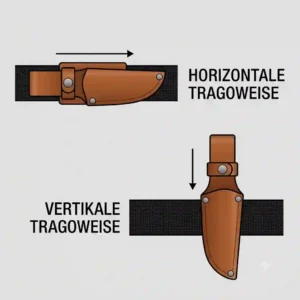
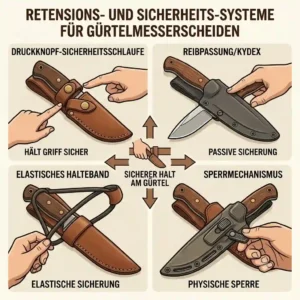
Moving away from traditional materials, the Armatus Architect represents the pinnacle of modern thermoplastic retention. Built from precision-molded Kydex, this sheath is designed primarily for fixed blades like the Bradford Guardian or ESEE series. The standout feature here isn’t just the Kydex itself, but the mil-spec Pull-the-Dot snaps. These snaps are directional—they only open when pulled from a specific angle, meaning a brush against a doorway or a scuffle won’t pop your sheath off your belt. This means you can confidently carry your blade in the horizontal “scout” position at the small of your back without fear of it slipping.
In my experience running tactical drills and navigating dense brush, the Architect solves the moisture rot problem inherent to leather. If you sweat heavily or work in maritime environments, this is your solution. It’s perfect for the outdoor adventurer or the tactical professional. However, the rigid nature of Kydex means there is zero forgiveness if you sit down in a tight bucket seat in your truck. The edge of the sheath will jab you if you don’t position it carefully at the 4 o’clock or 11 o’clock position.
Customer reviews continually praise the satisfying “click” of the blade locking into place, providing auditory confirmation of security. Priced typically in the mid-$40s to $60 range depending on the exact knife mold, it is arguably the best value in hard-use retention. It is practically indestructible, though I recommend checking the tension screws on the belt loops every few months with a drop of blue Loctite to prevent backing out.
3. Hide & Drink Leather Holder
When you want raw, unadulterated durability without the premium markup, the Hide & Drink Leather Holder is a fascinating study in minimalist engineering. Cut from a single piece of thick, full-grain leather and secured with heavy-duty brass hardware, this sheath is designed for standard folding knives (4 to 5 inches closed). What surprised me most during use was the sheer thickness of the leather. At this price point, you usually get bonded leather that flakes after a month. Instead, this material is thick enough to stop a blade tip from puncturing through if you accidentally drop the knife in point-first.
I constantly recommend this specific model to budget-conscious minimalists or traditionalists who carry a Buck 110 or a classic Trapper. The hidden drawback—which the manufacturer won’t highlight—is that the massive 2-inch belt loops can cause the sheath to slide back and forth on a standard 1.25-inch dress belt. You really need a dedicated 1.5-inch or wider work belt to lock this sheath securely on your hip. Furthermore, the open-top design relies purely on friction; there is no retention strap, so it is a bad fit for anyone doing acrobatics or inversion work.
Sitting comfortably in the under-$20 bracket, real-world users love the rustic aesthetic that patinas beautifully with age. It is a phenomenal entry-level choice that punches way above its weight class, proving that you don’t need to spend half a paycheck to secure your pocket knife responsibly.
4. Nite Ize Tool Holster Stretch
The Nite Ize Tool Holster Stretch abandons tradition entirely in favor of universal utility. Constructed from rugged ballistic nylon with elastic side panels, it accommodates a massive variety of knife shapes, multitools, and even small flashlights. The most critical engineering feature here is the 360-degree rotating rugged clip. Instead of threading a belt through loops, you clip this aggressively onto your waistband or duty belt, and you can rotate the tool to eight different locking positions. This means when you sit in an office chair or a vehicle, you can spin the knife horizontally instantly.
For the security guard, warehouse worker, or delivery driver constantly transitioning between standing and driving, this dynamic adjustment is a lifesaver. Most listings say it “fits all belts,” but I’ve found that on extremely thick double-layer leather gun belts, the plastic clip can struggle to seat fully over the bottom edge. Additionally, the Velcro flap closure is loud. If you need silent deployment in the woods while hunting, the aggressive tearing sound of the Velcro will give away your position instantly.
Community consensus points to its incredible versatility, though the elastic panels are the known weak point, often stretching out permanently after 14-18 months of heavy use. Falling in the highly accessible $10-$20 range, it’s an expendable but highly practical tool management system. It’s the ultimate “buy it to use it and abuse it” sheath.
5. Gentleman’s Hardware Canvas Pouch
Blending heritage aesthetics with modern weather resistance, this waxed canvas and leather hybrid offers a visually striking alternative to tactical gear. Designed with a sturdy brass snap closure and reinforced leather backing, it perfectly houses medium-sized folding knives. The waxed canvas is the hero here. While testing it during a weekend rainstorm, water beaded directly off the fabric. This provides superior corrosion resistance for your carbon steel blades compared to untreated leather, which acts like a sponge.
I found this to be the perfect companion for the weekend camper, the artisan, or the urban commuter who wants their gear to look sophisticated rather than militaristic. The dual-carry loops on the back allow for both standard vertical carry and horizontal belt mounting. What most buyers overlook is the break-in required for the snap itself; it is incredibly stiff out of the box and requires quite a bit of thumb force to pop open initially. I advise working the snap back and forth about fifty times before trusting it for one-handed deployment.
Priced in the $25-$35 range, reviews frequently highlight its handsome presentation, making it a highly gifted item. The value is excellent, provided you understand it is not designed for rapid-draw tactical situations, but rather for deliberate, stylish outdoor utility.
🔍 Ready to Upgrade Your EDC Setup?
Finding that perfect balance between comfort and accessibility is exactly what transforms a heavy, annoying tool into a seamless part of your daily routine. Don’t let a cheap pouch ruin the utility of a premium blade.
The Break-In Process: A Practical Usage Guide
Buying high-quality knife sheaths for belts is only step one. Unlike cheap nylon, premium materials like Kydex and thick cowhide require a deliberate break-in process. Failing to do this can result in lost tools or sheer frustration.
Mastering the Leather Mold
If you’ve purchased a tight leather slip, do not force your expensive knife into it dry. You risk tearing the stitching or permanently warping the leather. Instead, use the “Wax Paper Trick.” Wrap your knife tightly in two layers of standard kitchen wax paper. Gently push the wrapped knife into the sheath and leave it sitting in a warm (not hot) environment for 48 hours. The wax subtly lubricates the raw interior leather, while the paper adds just enough micro-thickness to stretch the hide perfectly. When you remove the paper, your knife will draw smoothly with a satisfying, glove-like retention.
Taming Kydex Tension
Kydex is memory-retentive plastic. If your sheath is too tight and dragging heavily on the blade’s finish, you can make micro-adjustments. First, ensure the tension screws are loosened slightly. If it’s still too tight around the trigger guard or the hilt, apply a hairdryer (never a heat gun, which will melt it) to the tightest spot for about 30-45 seconds until it is just warm to the touch. Insert the knife and gently twist. This micro-expansion will grant you a smoother draw without compromising the overall structural lock.
The First 30 Days: Mistakes to Avoid
During the first month, avoid the temptation to over-oil a leather sheath. Neatsfoot oil or Mink oil is great for conditioning, but soaking the leather will destroy its stiffness. A floppy sheath loses its retention friction, turning your belt setup into a drop hazard. Apply a pea-sized amount of conditioner only to the exterior every 6 months. For an in-depth look at material preservation, the National Park Service’s guide on leather conservation provides incredible insights into preventing environmental rot.
Real-World Scenarios: Matching the Sheath to the User
Every piece of gear is perfect for someone, but terrible for someone else. Let’s look at three distinct profiles to see how to match the user to the tool.
Profile 1: The Heavy-Duty Contractor
The Environment: Drywall dust, scaffolding climbs, tool belts, sweat.
The Perfect Fit: The Tale of Knives Multitool Flap Jax.
The Reality: A contractor needs tools instantly. Flapped pouches get in the way of gloved hands. The open-top friction fit of a heavy leather organizer means a utility blade is drawn and re-sheathed fifty times a day smoothly. Nylon would fray against brickwork within a week.
Profile 2: The Deep-Woods Hiker
The Environment: Unpredictable weather, heavy backpacks with hip belts, high physical exertion.
The Perfect Fit: The Armatus Carry Architect.
The Reality: When wearing a 60-liter backpack, the padded hipbelt completely covers standard vertical belt loops. The hiker needs horizontal “scout carry” at the front cross-draw or small of the back. Kydex won’t rot when submerged in a stream crossing, and the hard shell prevents the blade from puncturing the wearer during a steep fall.
Profile 3: The Corporate EDC Enthusiast
The Environment: Office chairs, tailored trousers, briefcases, client meetings.
The Perfect Fit: The Gentleman’s Hardware Canvas Pouch.
The Reality: Walking into a boardroom with a Kydex tactical rig screams “aggressive.” A discreet, waxed canvas pouch looks like a vintage accessory. It keeps a small pocket knife from ruining the silhouette of dress pants, providing utility without raising eyebrows in a strict corporate environment.
Problem-Solving: When Perfect Sheaths Fail
Even the best knife sheaths for belts encounter physics-based failures. Here is how to diagnose and solve the most common carry catastrophes.
The Sagging Belt Syndrome
The Problem: Your sheath constantly pulls your pants down on your dominant side, causing lower back pain and an unprofessional appearance.
The Solution: Stop blaming the sheath; the failure is your belt. Standard department store belts lack a rigid internal core. You must upgrade to a reinforced EDC or gun belt constructed with a polymer core between the leather layers. This distributes the 10-16 ounces of knife and sheath weight across your entire waistline rather than a single pivot point.
The “Dulling Draw”
The Problem: Your razor-sharp edge becomes dull after a week, despite barely cutting anything.
The Solution: You are suffering from “sheath drag.” In poor-quality designs, the blade edge rides directly against the brass rivets or hard stitching during the draw stroke. You must ensure you are drawing by pressing the spine of the blade against the back of the sheath, actively pulling the cutting edge away from the internal friction points.
The Seatbelt Snag
The Problem: Every time you exit your vehicle, the bottom tip of your vertical sheath catches the seatbelt or the steering wheel.
The Solution: Switch to a high-ride or “dangler” system. A dangler loop adds an O-ring between the belt loop and the sheath, allowing the entire rig to articulate and swing freely like a pendulum when you sit, rather than remaining a rigid stick jabbing into your ribs or the upholstery.
How to Choose Knife Sheaths for Belts Like a Pro
Walking into a gear shop or browsing online can be overwhelming. Here is my 5-step framework for filtering out the junk.
-
Assess the Ride Height: Where does the handle sit relative to the belt line? A “high-ride” keeps the knife hidden under an untucked shirt but requires extreme shoulder flexibility to draw. A “low-ride” is easy to grab but screams “look at my knife” to everyone in the grocery store.
-
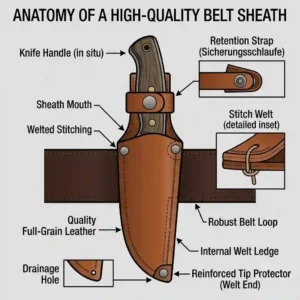
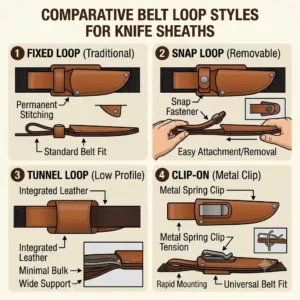
Evaluate the Belt Loop Anatomy: Look at the back. Are the loops sewn-in, riveted, or clipped? Sewn loops are strong but require taking your belt off. Clips are convenient but prone to popping off if you catch them on a doorframe.
-
Check the Drainage: For fixed blade sheaths, look at the bottom tip. Is there a weep hole? If not, rainwater and sweat will pool inside, creating a corrosive swamp that will rust a high-carbon blade in 48 hours.
-
Determine the Retention Type: Does it rely on Level 1 (friction), Level 2 (a thumb break/snap), or Level 3 (active locking mechanisms)? For civilian EDC, friction or a simple thumb snap is plenty.
-
Material Density: If buying leather, look for “Full Grain.” If the listing says “Genuine Leather,” walk away immediately. Genuine leather is the hot-dog meat of the leather world—scraps glued together that will peel and fail under stress. For a deeper understanding of leather grading, Wikipedia’s comprehensive breakdown of leather types is mandatory reading.
Leather vs Kydex vs Nylon: The Definitive Clash
When evaluating knife sheaths for belts, the material debate is where the community gets the most tribal. Let’s break down the actual science of these materials.
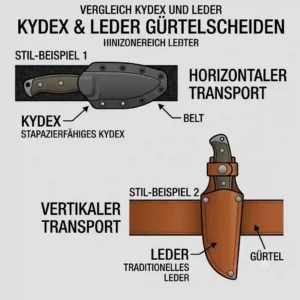
Full-Grain Leather is a biological material. It breathes, which allows minor moisture to evaporate. Over time, it conforms to your body mechanics, creating a bespoke fit that nothing else can replicate. However, its cellular structure breaks down over decades. It is susceptible to dry rot, mold, and stretching. If you draw a blade improperly and slice the inside of a leather sheath, that structural damage is permanent.
Kydex (Acrylic-polyvinyl chloride) is an engineering marvel. It is entirely waterproof, chemically resistant to oils and solvents, and can be molded to the exact millimeter of a blade’s contour. It provides a tactile, auditory “click” that confirms retention. However, it is an insulator. If you put a cold blade into a warm Kydex sheath, condensation will form inside. Furthermore, Kydex traps dirt. A grain of sand stuck in a Kydex sheath will aggressively scratch the finish of your blade every time you draw it.
Ballistic Nylon was developed for flak jackets. It is incredibly abrasion-resistant and inexpensive to manufacture. Nylon sheaths are often universal, using elastic and velcro to accommodate different tools. The trade-off is absolute lack of character and poor edge protection. A sharp knife can slice through basic nylon if the internal plastic liner fails.
Looking at this material breakdown, Kydex is the undisputed champion for tactical and maritime operations, while Leather dominates the heritage and everyday comfort space. Nylon should be reserved for duty belts where cost-replacement and modularity are prioritized over long-term aesthetics.
Common Mistakes When Buying Belt Sheaths
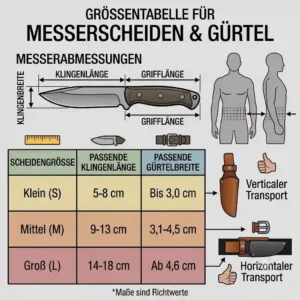
The most egregious error I see buyers make is ignoring the belt width. You will buy a premium $80 sheath designed for a 1.5-inch belt and thread it onto a 1-inch dress belt. The result? The sheath flops around like a wet noodle, changing its draw angle with every step. When you reach for it in an emergency, it’s not where muscle memory expects it to be.
Another massive mistake is the false economy of cheap hardware. A sheath is only as strong as its weakest rivet. You can have the finest English Bridle leather in the world, but if the manufacturer used cheap aluminum snaps instead of solid brass or stainless steel, the snap will shear off the first time you snag it on a steering wheel. Always investigate the hardware specs; if they aren’t proudly listing the metal type, assume it’s cheap pot metal.
Finally, buyers often fall victim to the multi-tool trap. They buy a massive, quadruple-pocket sheath to carry a knife, a flashlight, a pen, a pry bar, and a lighter. After three days, they realize they are carrying three pounds of gear on their left hip, throwing out their back alignment. Buy for your 90% use-case, not your 1% fantasy scenario.
Long-Term Cost & Maintenance: The 12-Month Lifecycle
What is the true cost of owning premium knife sheaths for belts? Let’s look at the Year One roadmap.
If you purchase a $50 leather sheath, your investment does not end there. By month three, environmental dust and sweat will have leached the natural oils from the hide. You must invest in a high-quality leather balm (around $10-$15). By month six, depending on how tightly you draw your knife, you may notice edge-fray on the stitching. A quick pass with a lighter (to melt nylon thread ends) or an application of beeswax is required.
If you opt for Kydex, your financial maintenance is lower, but your hardware maintenance is higher. Around month four, the micro-vibrations from walking will begin to back out the Chicago screws holding your belt clips. You will need a Torx or Allen key set and a bottle of threadlocker. If you lose a proprietary screw in the woods, you are suddenly without a carry system.
The “Efficiency Gap” here is clear: Nylon requires zero maintenance but has a 100% replacement rate every 1-2 years. Leather requires quarterly maintenance but can last 20 years. Kydex requires mechanical check-ups but survives physical trauma that would destroy the others.
Concealed vs Open Carry: Safety & Compliance Guide
Note: I am an equipment expert, not a lawyer. Always consult local statutes.
Carrying a knife on your belt is not just a fashion statement; it is a legal liability. In many jurisdictions, the visibility of your sheath completely changes your legal standing. For example, carrying a fixed blade openly on your belt in a traditional leather sheath may be perfectly legal in rural areas. But the moment you put on a jacket that covers that sheath, you have crossed into “concealed carry of a deadly weapon” territory in several states.
When choosing knife sheaths for belts, consider how your wardrobe interacts with the ride height. An “IWB” (Inside the Waistband) Kydex rig is specifically designed for deep concealment. Conversely, a large dangler leather sheath is impossible to hide.
Furthermore, consider the “social friction.” A beautifully crafted leather sheath holding a traditional bone-handled folder is often viewed by the public as a “grandpa tool.” A black Kydex rig holding an aggressively serrated tactical blade is viewed as a weapon. Your choice of sheath dictates the narrative of the tool you carry. For a baseline understanding of how these laws fluctuate, the American Knife & Tool Institute (AKTI) maintains highly accurate, state-by-state legislative maps.
Features That Actually Matter (And The Fluff to Ignore)
In 2026, the EDC market is flooded with marketing buzzwords. Here is how to separate the essential from the exhausting.
Feature That Matters: Welted Seams
In a leather sheath, a “welt” is a third piece of leather sandwiched between the front and back pieces along the cutting edge. This creates a thick wall that the blade edge rides against, preventing the knife from slicing through the stitches over time. If a leather fixed-blade sheath does not have a welt, do not buy it. It is inherently unsafe.
The Fluff to Ignore: “Tactical Cordura Paracord Wrap”
Many modern sheaths come wrapped in 15 feet of paracord, marketed as a “survival necessity.” In reality, the paracord acts as a sponge, soaking up sweat, blood, and mud, creating a stinking, unsanitary mess on your hip. Furthermore, it adds unnecessary bulk to the sheath’s profile.
Feature That Matters: Modular Hole Spacing
On Kydex sheaths, look for eyelets that are spaced exactly 0.75 inches apart or 1.5 inches apart. This is the industry standard for mounting aftermarket hardware like Tek-Loks, UltiClips, or MOLLE-Loks.
The Fluff to Ignore: Built-In Firestarter Loops
Unless you are actively bushcrafting, a ferro-rod loop on the side of your daily office sheath is a massive annoyance that catches on seatbelts and chair arms. Keep your fire starting gear in your backpack, not on your hip.
The Final Verdict: Upgrading Your EDC
The reality of optimizing your everyday carry is that the blade is only half the equation. You can own the sharpest, most metallurgically advanced knife on the planet, but if it is sitting at home because your carry system is uncomfortable, it is completely useless.
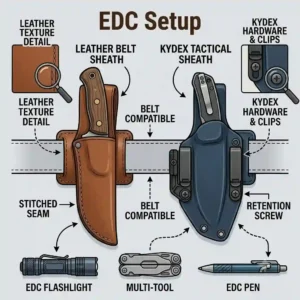
When evaluating knife sheaths for belts, you must look inward at your daily routine before you look outward at the products. The rugged, multi-tool capability of the Tale of Knives rig is unparalleled for the working professional, while the unyielding, waterproof nature of the Armatus Architect makes it the undisputed king of the backcountry. Don’t settle for the cheap nylon sleeve that came free in the box. Invest in a proper carry system, commit to the break-in process, and transform how you interact with your tools on a daily basis.
FAQs
❓ What is the most durable material for a knife sheath?
✅ Kydex and custom-molded thermoplastics are currently the most impact and weather-resistant materials available. They are completely waterproof and will not rot, stretch, or degrade under UV light, making them superior for extreme environmental durability…
❓ How do I stop my belt sheath from sliding around?
✅ Ensure your belt width precisely matches the sheath’s belt loop width (e.g., a 1.5″ loop on a 1.5″ belt). Upgrading to a rigid, polymer-core EDC belt also prevents the material from crushing and sliding under the weight of the tool…
❓ Are horizontal knife sheaths comfortable for sitting?
✅ Yes, horizontal (scout carry) sheaths are highly comfortable for driving or sitting in office chairs because they align parallel to the waistline. However, they must be positioned carefully at the 11 o’clock or 5 o’clock position to avoid spinal pressure…
❓ Can I oil my leather sheath with WD-40?
✅ Absolutely not. Petroleum-based lubricants like WD-40 will break down the cellular structure of natural leather, causing irreversible rot. Only use natural, animal-based conditioners like Neatsfoot oil or beeswax-based leather balms designed specifically for saddlery…
❓ Why is my Kydex sheath scratching my knife blade?
✅ Hard thermoplastic sheaths trap environmental grit. When dust or sand gets inside the sheath, the tight friction fit forces those hard particles against the steel during the draw. Routinely flush Kydex sheaths with warm soapy water to clear out debris…
Recommended for You
- 5 Best Cowboy Knife Sheath Options in 2026 (Expert Tested)
- Leather knife pouch: 5 best rugged options for 2026 EDC
- 5 Best Knife Sheaths to Protect Your Edge: 2026 Field Guide
Disclaimer: This article contains affiliate links. As an Amazon Associate, I earn from qualifying purchases. If you purchase products through these links, we may earn a small commission at no additional cost to you.
✨ Found this guide helpful? Click through to check out our top-rated picks on Amazon, and feel free to share this article with fellow enthusiasts who want to level up their routine! 💬🤗
[addtoany]
